Autodoc’s IPO Delay: Venture Confidence in Flux
The abrupt postponement of Autodoc SE’s Frankfurt Stock Exchange debut on June 24, 2025, just hours before its scheduled trading commencement, represents more than an isolated corporate decision. The German automotive e-commerce leader’s withdrawal from what would have been one of the largest German IPOs of the year illuminates deeper structural challenges facing Europe’s capital markets in 2025. As the continent’s IPO landscape navigates heightened volatility, macroeconomic uncertainty, and shifting investor sentiment, Autodoc’s delay serves as a barometer for broader market health and venture confidence across the region.
The Postponement: A Market Signal
Autodoc’s last-minute decision to shelve its €389 million IPO came despite sufficient investor demand to cover the full deal size. The company had narrowed its price guidance in the final stages, indicating pricing pressure. The timing proved particularly stark, with order taking scheduled to close mid-afternoon on the day of the planned listing, only to see the company announce its withdrawal shortly thereafter.
The postponement involved both the company’s founders and private equity backer Apollo Global Management, who were set to sell existing shares rather than raise new capital for corporate purposes. This secondary offering structure, while common in mature private equity exits, placed additional pressure on achieving attractive valuations in a challenging market environment. Apollo Global Management, one of the world’s largest private equity firms, represents the caliber of institutional backing that typically ensures successful public market transitions.
European IPO Market Dynamics
The broader European IPO market context reveals a tale of two halves, with 2024’s remarkable recovery giving way to 2025’s renewed challenges. European IPO proceeds more than doubled from 2023 to 2024, driven by significant listings in various sectors. The recovery reflected improving macroeconomic conditions, moderating inflation, and decisive election results across key European markets.
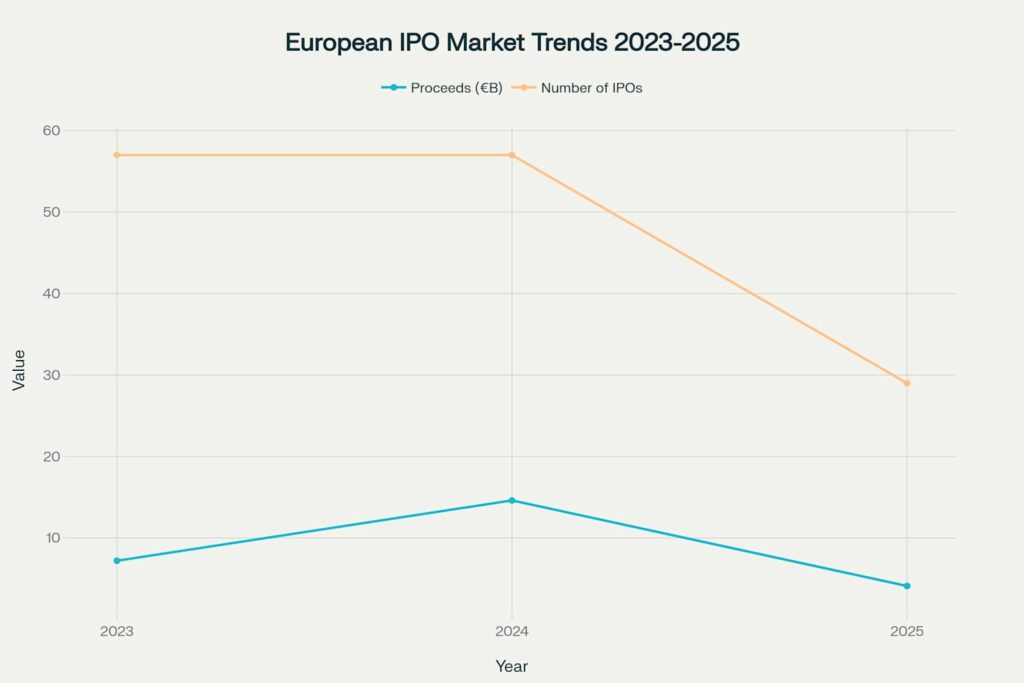
However, 2025 has witnessed a sharp reversal, with European IPO proceeds falling significantly in the first quarter compared to the same period in 2024. The number of European IPOs also dropped, while total issuance volume decreased substantially. This deterioration reflects increased market volatility driven by uncertainty around global trade tariffs, geopolitical tensions, and cooler sentiment toward technology stocks that had surged during 2024.
Frankfurt’s Position in the European Landscape
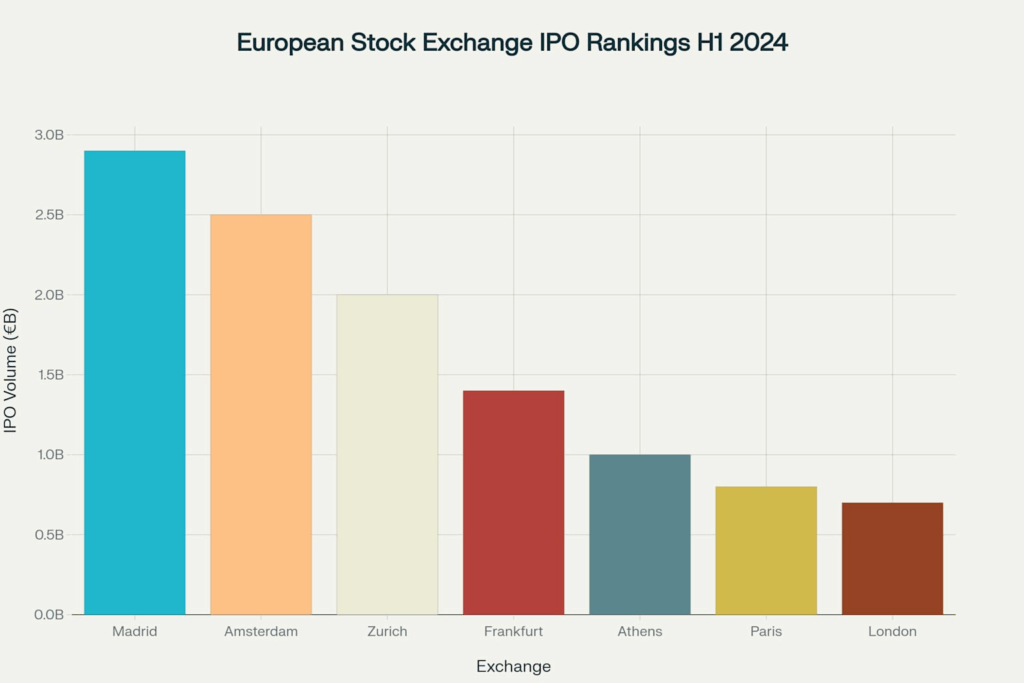
Frankfurt’s performance within the European IPO ecosystem underscores the challenges facing German capital markets specifically. In the first half of 2024, Frankfurt ranked fourth among European exchanges for IPO volume, trailing Madrid, Amsterdam, and Zurich with just two major listings totaling approximately €1.4 billion. This positioning reflected broader structural issues within Germany’s IPO infrastructure, including limited risk appetite among domestic institutional investors and insufficient equity culture compared to markets like the UK and US.
The German IPO market recorded only a handful of listings in the Prime Standard segment during 2024, representing minimal growth compared to 2023. Total placement volume declined year-over-year, marking one of the lowest levels in the past decade. Most new German public companies traded below their issue prices, highlighting the challenging post-IPO performance environment that deters both issuers and investors.
Autodoc’s Business Fundamentals
Despite the IPO postponement, Autodoc’s underlying business metrics demonstrate the strength that initially attracted public market interest. The company achieved robust revenue growth in 2024, maintaining solid adjusted EBITDA and profit margins. With millions of products from thousands of manufacturers serving millions of active customers across numerous European countries, Autodoc has established itself as the continent’s largest online automotive parts retailer.
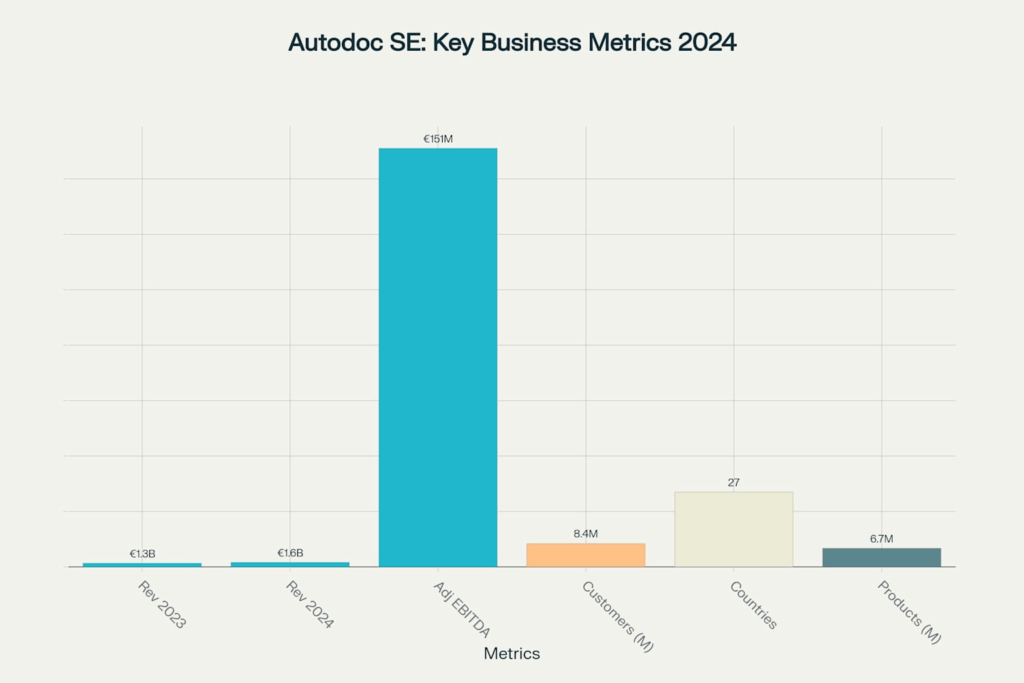
The company’s financial profile includes debt-free operations, strong free cash flow generation, and consistent multi-year growth. Autodoc’s market position benefits from the ongoing digitalization of Europe’s independent automotive aftermarket, where online sales still represent a small fraction of the total market, suggesting significant expansion potential. The company’s expansion into B2B services targets professional market participants including garages and repair shops.
Venture Capital and Exit Environment
The venture capital landscape supporting European technology companies has shown resilience despite public market challenges, though exit opportunities remain constrained. European venture capital recorded strong increases across all activity measures in 2024, with fundraising and investment rising significantly. VC investment in Europe remained steady in early 2025, though deal volume declined markedly.
The European Venture Sentiment Index reached a positive level in early 2025, reflecting improvements in labor market conditions, credit affordability, and macroeconomic outlook despite persistent uncertainty. However, the exit environment remains challenging, with many European VC funds failing to return capital to limited partners, reflecting difficulties in securing liquidity through public offerings or strategic acquisitions.
Macroeconomic Headwinds
The macroeconomic environment presents both supportive and challenging elements for IPO activity across Europe. The European Central Bank lowered interest rates in mid-2025, with inflation near target levels and modest GDP growth projected over the coming years. Nonetheless, uncertainty surrounding trade policies is expected to weigh on business investment and exports.
Global IPO activity has experienced significant headwinds in 2025, with volumes declining to the lowest level in nearly a decade. Economic policy uncertainty has emerged as a significant driver of IPO frequency, as increased uncertainty leads to unfavorable market conditions and weaker IPO landscapes. During periods of heightened policy uncertainty, firms’ cost of capital increases, potentially discouraging public offerings as companies prioritize better offer prices over immediate capital access.
Implications for Market Health
The convergence of factors surrounding Autodoc’s postponement reveals several critical implications for European IPO market health. Market volatility has reached levels that make timing IPOs increasingly difficult, with companies facing the choice between accepting lower valuations or waiting for more favorable conditions. The IPO window has become notably tight, with opportunities opening and closing rapidly based on geopolitical developments, trade policy uncertainty, and sector-specific sentiment shifts.
European exchanges are experiencing divergent performance, with some markets maintaining momentum while others struggle with limited investor appetite and infrastructure constraints. The preference for US listings among high-growth European technology companies continues to drain potential deal flow from domestic exchanges. This dynamic reinforces the challenges facing European capital markets in building sufficient depth and liquidity to compete with established US venues.
Shifting Investment Priorities
The venture capital ecosystem’s evolution reflects changing priorities that influence exit strategies and IPO timing decisions. AI and machine learning investments have surged to prominence in European VC deal value, surpassing traditional SaaS investments for the first time. This sectoral rotation demonstrates how investor preferences can rapidly shift, creating windows of opportunity for some companies while challenging others.
Private equity firms face increasing pressure to deliver returns to limited partners, particularly as funds raised during the peak period approach their typical hold durations. The limited IPO exit environment forces these firms to consider alternative strategies, including secondary sales, strategic acquisitions, or extended hold periods that defer exit timelines. For companies like Autodoc with strong fundamentals but challenging market timing, this creates strategic tension between optimal exit conditions and investor return expectations.
Conclusion
Autodoc’s IPO postponement encapsulates the complex dynamics currently governing Europe’s capital markets, where strong business fundamentals intersect with challenging market conditions and investor sentiment. The company’s withdrawal, despite adequate investor demand, signals that achieving attractive valuations has become increasingly difficult in an environment characterized by heightened volatility, economic policy uncertainty, and sector-specific headwinds. While European IPO activity demonstrated remarkable recovery in 2024, the sharp decline in early 2025 reflects the fragility of this momentum.
The broader implications extend beyond individual company decisions to fundamental questions about European capital market competitiveness and infrastructure. Frankfurt’s ranking among European exchanges and Germany’s limited IPO activity underscore structural challenges that require long-term solutions, including enhanced equity culture development and reduced regulatory barriers for growth companies. As venture capital continues flowing into European technology companies while exit opportunities remain constrained, the tension between private market valuations and public market acceptance will likely intensify.
The path forward requires patience from both issuers and investors as market conditions stabilize and economic policy uncertainty diminishes. Autodoc’s decision to maintain IPO consideration “at a later time” reflects the pragmatic approach companies must adopt in navigating volatile public market conditions while preserving long-term strategic optionality. The health of Europe’s IPO market will ultimately depend on the convergence of improved macroeconomic stability, reduced geopolitical tensions, and renewed investor confidence in growth company valuations.