Amazon’s Rural Push: Growth Opportunity or Monopoly in the Making?
Amazon’s aggressive $4 billion rural expansion represents not a benevolent growth opportunity for underserved communities, but a calculated monopolization strategy that will systematically eliminate local competition while creating unsustainable dependencies in America’s heartland. This massive infrastructure investment, disguised as rural economic development, is fundamentally a pre-emptive strike against competitors and a blueprint for market domination that threatens the very fabric of local commerce.

The Scale of Amazon’s Rural Ambition
The sheer magnitude of Amazon’s rural logistics offensive reveals the strategic nature of this expansion. By 2026, Amazon plans to triple its rural delivery network to over 200 stations, covering 13,000 zip codes across 1.2 million square miles—an area equivalent to Alaska, California, and Texas combined. This isn’t incremental growth; it’s territorial conquest.
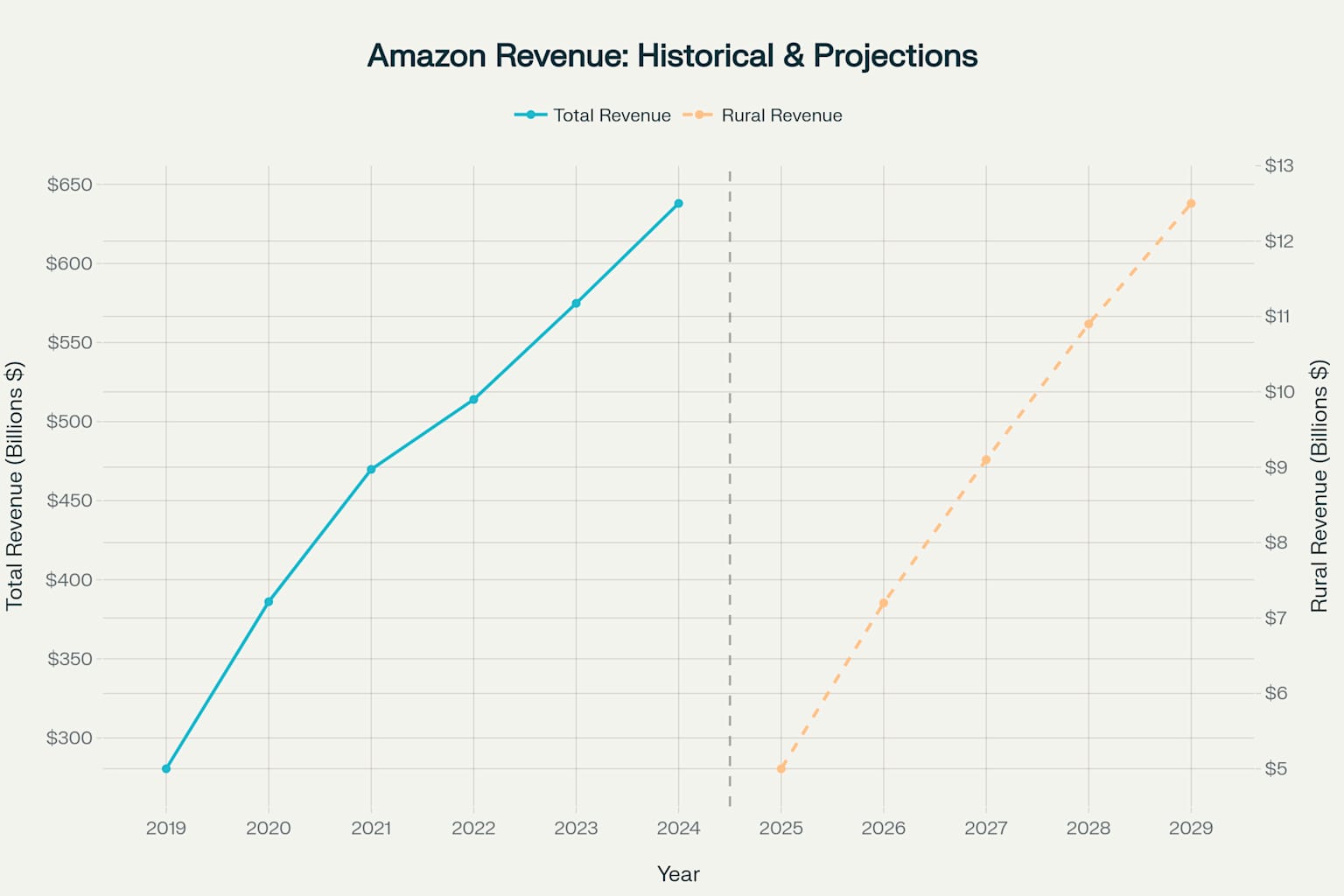
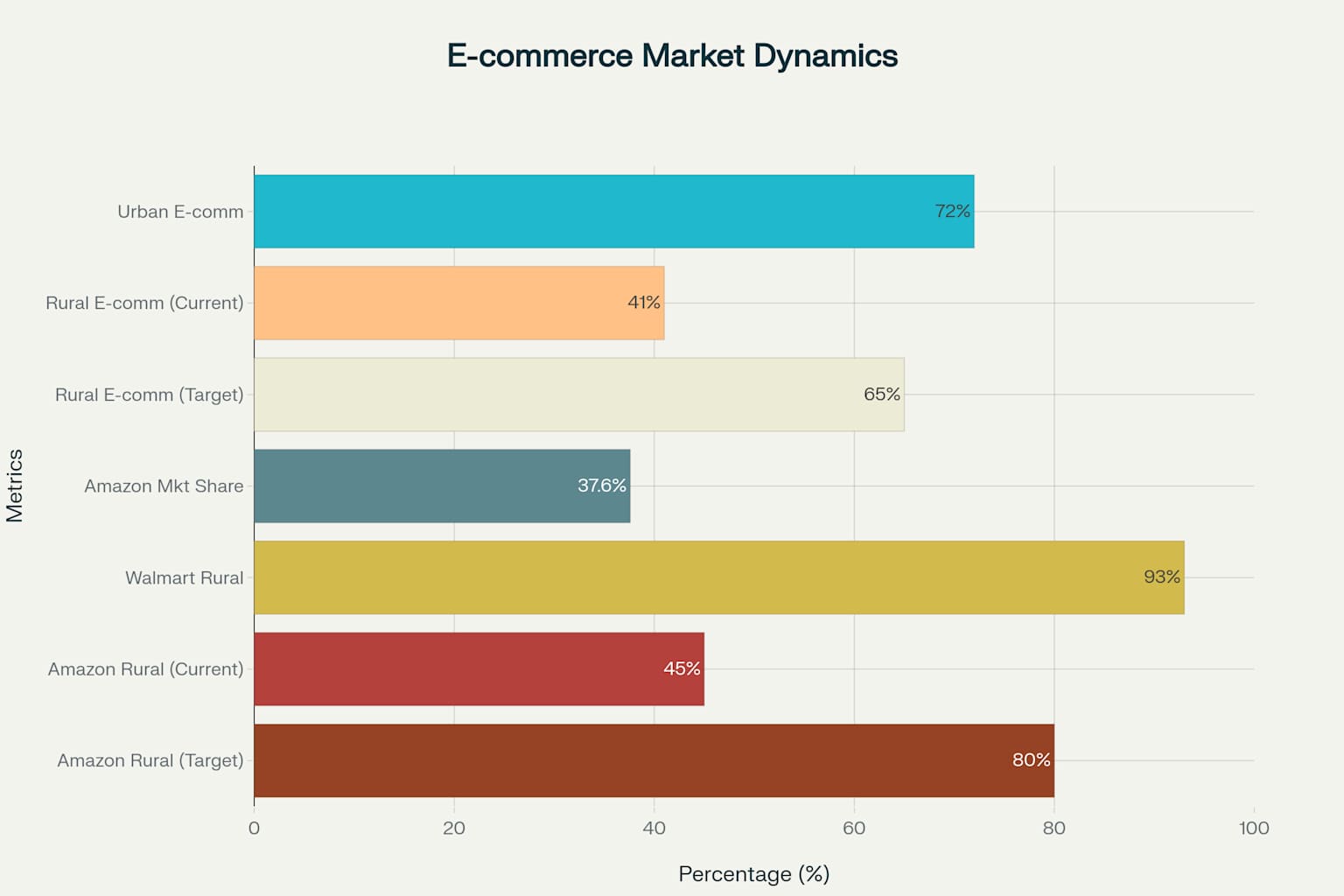
The financial projections underlying this expansion expose Amazon’s long-term monopolization strategy. With rural e-commerce penetration currently at just 41% compared to 72% in urban areas, Amazon has identified a $28.8 billion market expansion opportunity. Morgan Stanley analysts correctly characterize this as a “$1 trillion opportunity,” representing one-fifth of all non-automotive, non-gasoline spending in non-metropolitan counties.
The Economics of Market Domination
Amazon’s rural investment strategy becomes clearer when analyzed through the lens of competitive positioning rather than rural development. While Amazon currently holds 37.6% of the overall U.S. e-commerce market, Walmart maintains superior rural coverage with same-day delivery to 93% of U.S. households. Amazon’s rural expansion directly targets this competitive disadvantage, aiming to increase its rural coverage from 45% to 80%.
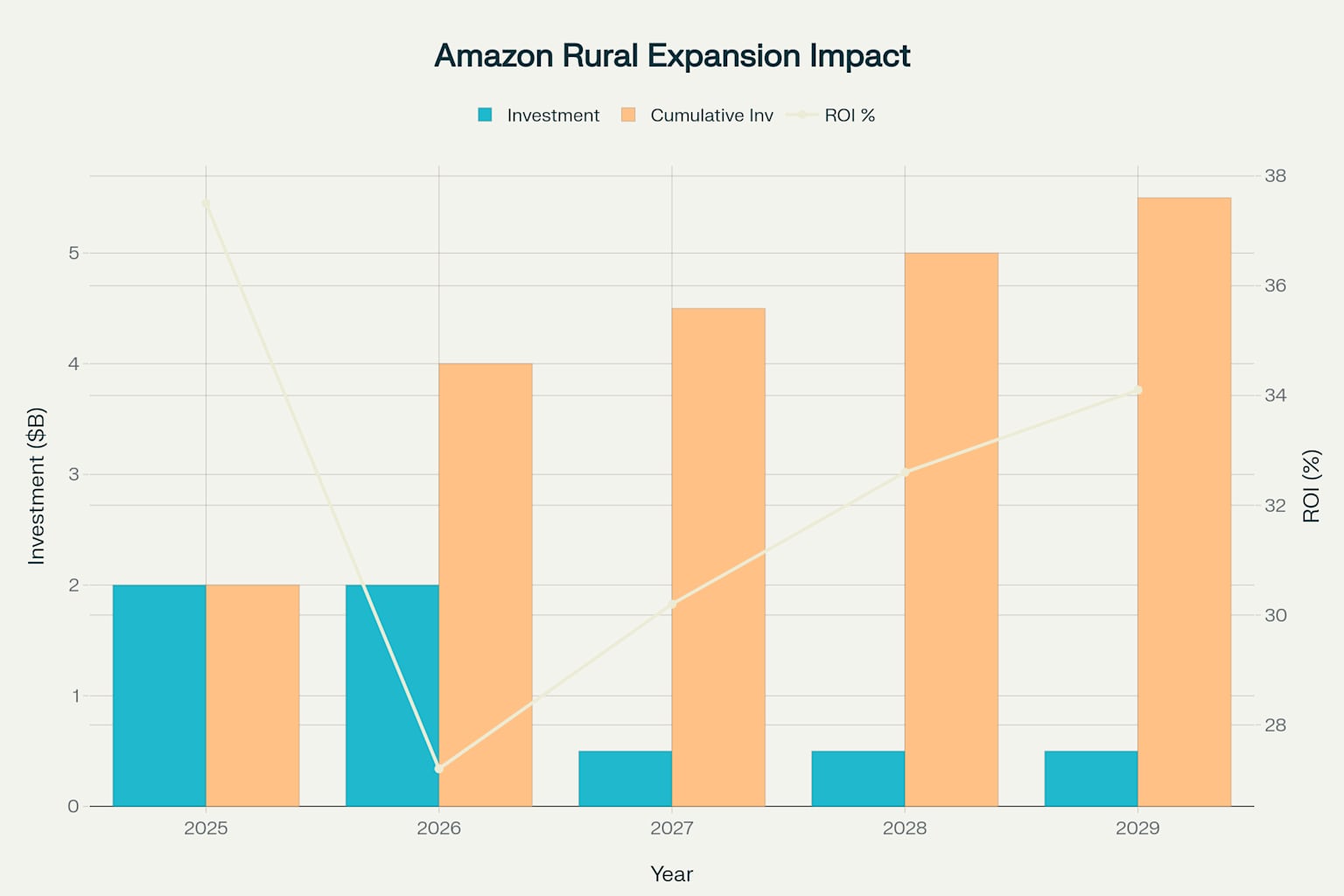
The financial mathematics reveal the monopolistic intent. Amazon’s projected rural revenue growth from $5 billion in 2025 to $12.5 billion by 2029 represents a compound annual growth rate exceeding 25%. With an estimated payback period of just 0.1 years and ROI consistently above 30%, this investment generates returns that can only be achieved through market domination, not competitive markets.
The Systematic Elimination of Local Competition
Amazon’s rural strategy employs classic predatory pricing and market flooding tactics. The company’s ability to offer prices 14% lower than major retailers stems not from operational efficiency but from cross-subsidization through its massive urban profit centers. Local retailers, operating on thin margins without access to vast capital reserves, cannot compete with this artificially sustained pricing model.

Source: alamy
The employment narrative, while superficially attractive, masks the destructive competitive effects. Amazon’s promise of 100,000 jobs paying “nearly triple the federal minimum wage” at $21.75 per hour represents a classic market disruption strategy. By offering wages that local retailers cannot match, Amazon simultaneously attracts the best workers while forcing competitors to either raise costs or accept inferior labor pools.
Research on rural grocery stores reveals the vulnerability of existing retailers. In Minnesota, 88% of rural grocers express concern about long-term sustainability, with 49% fearing closure within five years. Amazon’s expansion will accelerate this consolidation, leaving communities dependent on a single dominant retailer.

Source: nytimes
Market Concentration and Antitrust Implications
The monopolization risk becomes quantifiable through market concentration analysis. Amazon’s rural expansion threatens to push the Herfindahl-Hirschman Index above 0.52 in rural markets, well into the range considered highly concentrated by antitrust authorities. This concentration level typically triggers regulatory intervention, yet Amazon’s expansion proceeds unchallenged.
The Federal Trade Commission’s September 2023 lawsuit against Amazon provides crucial context. The 170-page complaint details how Amazon “uses a set of punitive and coercive tactics to unlawfully maintain its monopolies.” These same tactics—anti-discounting measures, forced Prime eligibility, and algorithmic suppression of competitors—will be deployed with devastating effect in rural markets where competitive alternatives are already limited.
Addressing the Economic Development Counterargument
Proponents argue that Amazon’s rural expansion provides essential economic development for underserved communities. This narrative, while emotionally compelling, obscures the long-term economic costs of monopolization. The $8.14 billion total economic impact, while substantial, represents a classic example of short-term gains masking long-term dependency.
The “jobs creation” argument fails under scrutiny when examined against job displacement. While Amazon creates 170 jobs per delivery station, the closure of multiple local retailers typically eliminates more positions than Amazon creates. These displaced workers often lack the technical skills required for Amazon’s logistics roles, creating structural unemployment in rural communities.
Furthermore, Amazon’s rural jobs come with hidden costs. The company’s notorious surveillance and productivity monitoring systems, documented extensively in urban facilities, will transform rural work environments. Local retailers, despite lower wages, often provide more humane working conditions and greater worker autonomy.
The infrastructure argument also proves hollow upon examination. Amazon’s delivery stations serve Amazon’s network, not community infrastructure needs. Unlike traditional economic development that creates multiplicative effects through local supply chains, Amazon’s operations function as extraction mechanisms that channel rural spending toward Seattle headquarters.
The Path to Rural Retail Monopoly
Amazon’s rural expansion follows a predictable pattern of market capture. Initial investment creates artificially attractive service levels—same-day delivery, lower prices, vast selection—that local competitors cannot match. Once market share reaches critical mass, Amazon can gradually reduce service quality while maintaining dominance through switching costs and market barriers.
The Hub Delivery program exemplifies this strategy. By partnering with local flower shops and small businesses for package delivery, Amazon co-opts potential competitors into its distribution network. These businesses become dependent on Amazon’s revenue while simultaneously facilitating the broader Amazon strategy that will ultimately destroy their core retail operations.
Machine learning algorithms enable unprecedented market manipulation in rural areas. Amazon’s systems predict “which items will resonate with local Prime members based on their unique needs,” creating artificial demand patterns that favor Amazon’s inventory while making local retailers appear inadequate.
The Regulatory Response Imperative
The Federal Trade Commission must recognize Amazon’s rural expansion as an extension of the monopolistic practices detailed in its 2023 lawsuit. Chair Lina Khan’s characterization of Amazon as “a monopolist that uses its power to hike prices on American shoppers and charge sky-high fees” applies with particular force to rural markets where competitive alternatives are limited.
Antitrust enforcement should focus on preventing Amazon from cross-subsidizing rural operations through urban profits. Rural pricing that reflects true operational costs, rather than predatory subsidization, would create space for competitive alternatives to survive and thrive.
State and local governments must also resist the temptation of short-term economic benefits. Communities should negotiate binding commitments regarding service levels, employment guarantees, and competitive practices before approving Amazon facilities.
Conclusion: Monopoly in the Making
Amazon’s rural expansion represents monopolization by design, not accident. The company’s massive investment, superior to any competitor’s capacity, combined with predatory pricing and systematic competitive suppression, creates an inevitable path toward rural retail monopoly. While communities may experience short-term benefits from job creation and improved service, the long-term costs of market concentration far exceed these temporary gains.
The $4 billion investment should be understood not as rural development but as the price Amazon is willing to pay to eliminate competition in America’s heartland. Unless regulators intervene decisively, Amazon’s rural push will transform independent local retailers into an extinct species, leaving rural Americans dependent on a single corporate entity for their daily needs.
The choice facing policymakers is clear: allow Amazon to complete its rural monopolization strategy, or enforce antitrust laws to preserve competitive markets that serve consumer interests over corporate dominance. The time for action is now, before Amazon’s rural conquest becomes irreversible.
Editor’s Note: This is an opinion column and represents the views of the author. It does not necessarily reflect the views of this publication.