The Dollar’s Twilight: Why Central Banks Are Fleeing America’s Currency
The global financial order that has underpinned American economic supremacy for eight decades is crumbling before our eyes, as central banks worldwide orchestrate an unprecedented exodus from U.S. dollar reserves—a seismic shift that signals the fundamental erosion of America’s economic hegemony, driven by reckless fiscal policies and political instability that have transformed the world’s former safe haven into a liability too dangerous to hold.
The Great Unwinding: Data Reveals Historic Dollar Abandonment
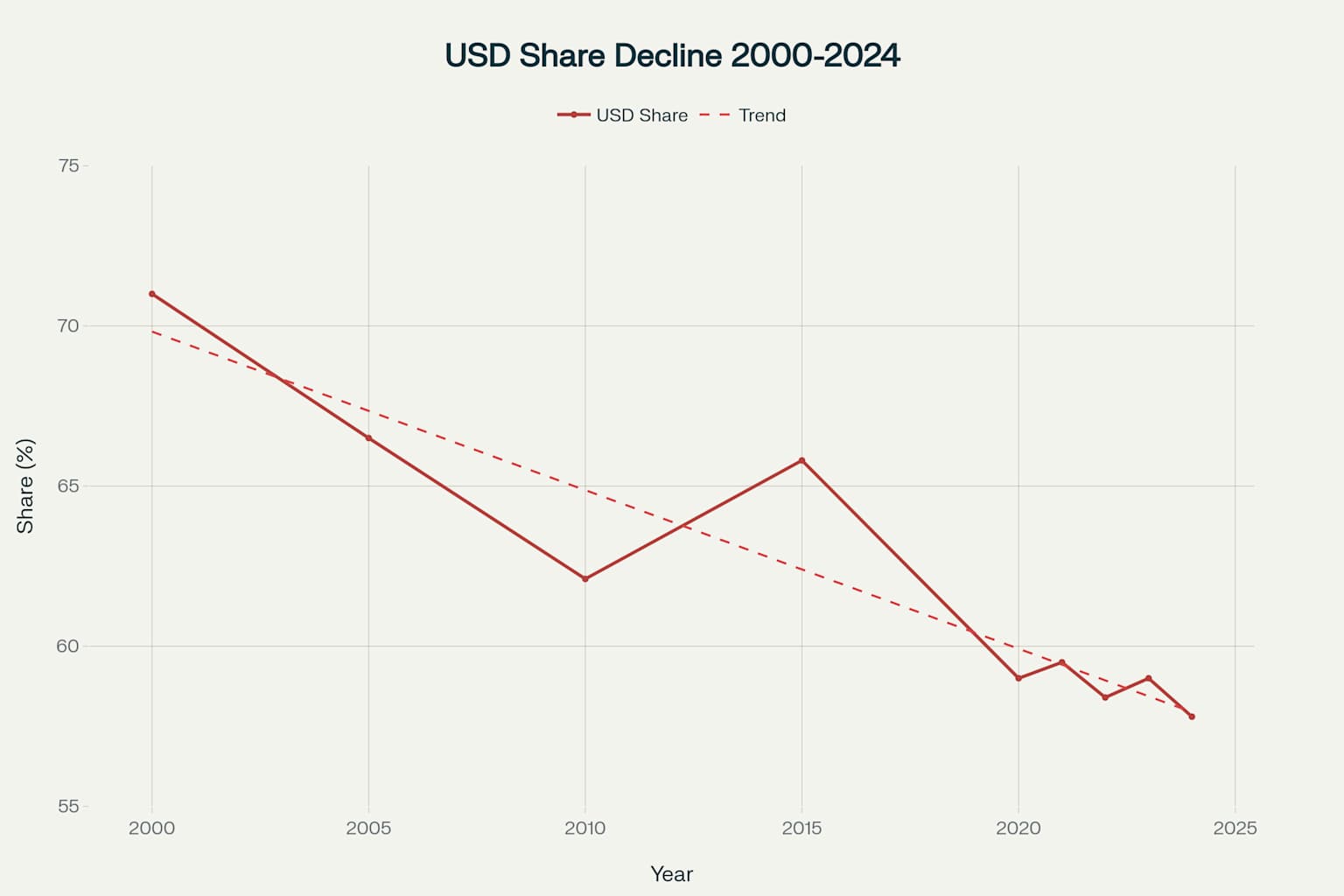
The evidence of this tectonic shift is overwhelming and undeniable. The dollar’s share of global foreign exchange reserves has collapsed from 71% in 2000 to just 57.8% in 2024—a staggering 13+ percentage point decline that represents the steepest erosion of monetary dominance since the British pound’s demise following World War II. This isn’t merely a statistical blip; it’s the death knell of dollar hegemony.
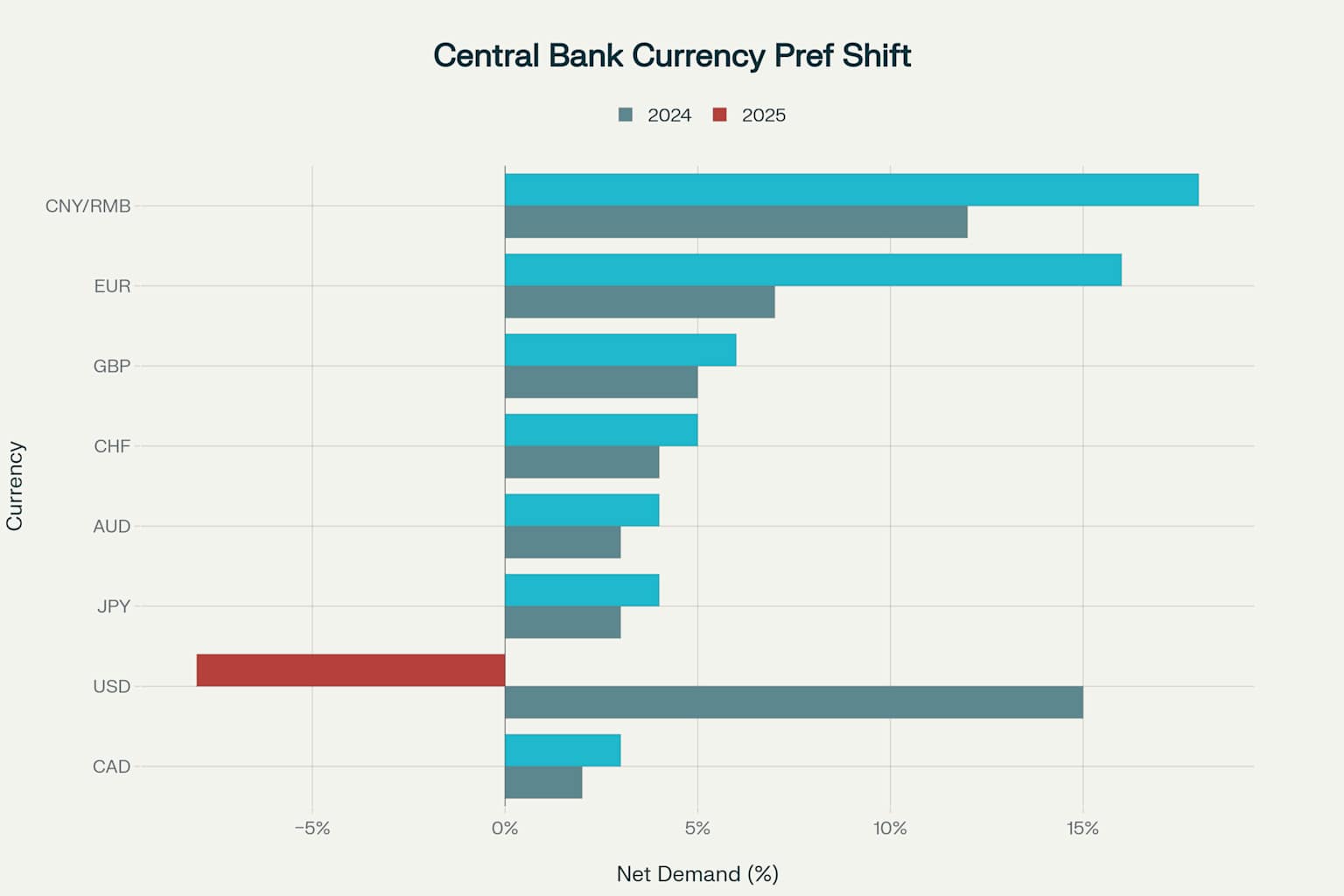
Central banks managing over $7 trillion in global reserves are not just diversifying—they’re fleeing. The latest survey data from the Official Monetary and Financial Institutions Forum reveals a stunning reversal: while 15% of central banks planned to increase dollar exposure in 2024, a net 8% now plan to reduce their holdings in 2025—a 23 percentage point swing that represents the most dramatic shift in reserve manager sentiment on record. Meanwhile, demand for the euro surged from 7% to 16% net positive, and Chinese yuan demand jumped from 12% to 18%.
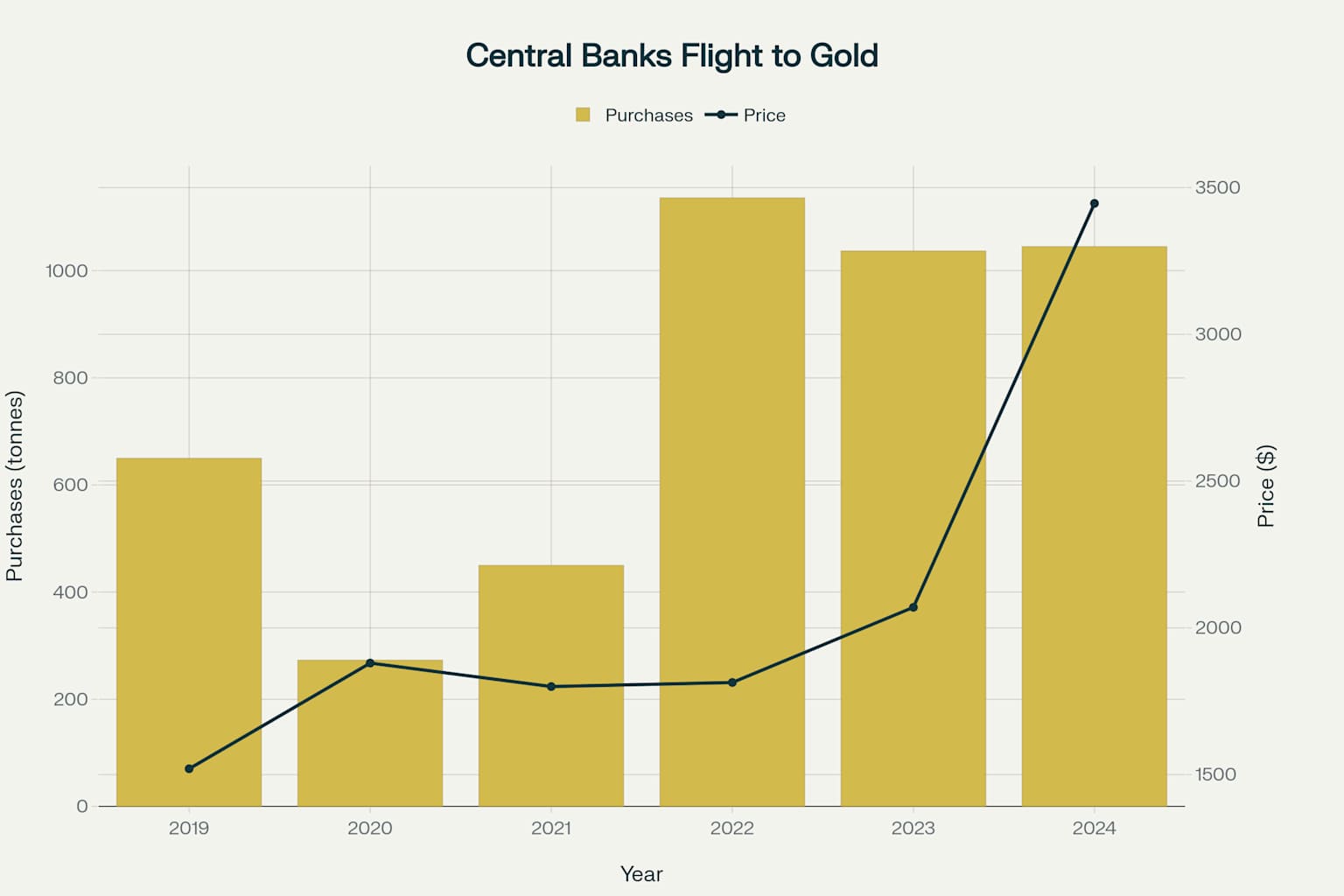
This flight from dollars has triggered an unprecedented rush into gold, with central banks purchasing over 1,000 tonnes annually for three consecutive years—levels not seen since the 1970s. The correlation is unmistakable: as dollar confidence erodes, gold prices have more than doubled from $1,520 in 2019 to $3,446 in 2024.
America’s Fiscal Recklessness: The Root of Dollar Decay
The catalyst for this historic abandonment lies in America’s spectacular fiscal irresponsibility. The U.S. budget deficit has exploded to $1.9 trillion for fiscal year 2025, representing 6.5% of GDP—levels typically associated with wartime or economic crisis, not peacetime prosperity. Yet this represents the new normal, as structural deficits are projected to average 6.3% of GDP over the next three decades.
The mathematics are devastating: interest payments on the national debt have surged from $375 billion in 2019 to a projected $950 billion in 2025—a 153% increase that now consumes nearly 20% of all federal revenues. Projections show debt will reach 156% of GDP by 2055 under current policies, or a catastrophic 220% if proposed tax cuts are enacted. These are not the fundamentals of a reserve currency; they are the hallmarks of a failing state.
The weaponization of the dollar through sanctions has accelerated this decline. From Russia’s exclusion from SWIFT to the freezing of $630 billion in Russian reserves, America has demonstrated that dollar holdings are conditional on political compliance. As China’s central bank governor recently warned, established cross-border payment frameworks can be readily politicized and weaponized, serving as instruments for unilateral sanctions.
The Multipolar Future: Quantitative Projections
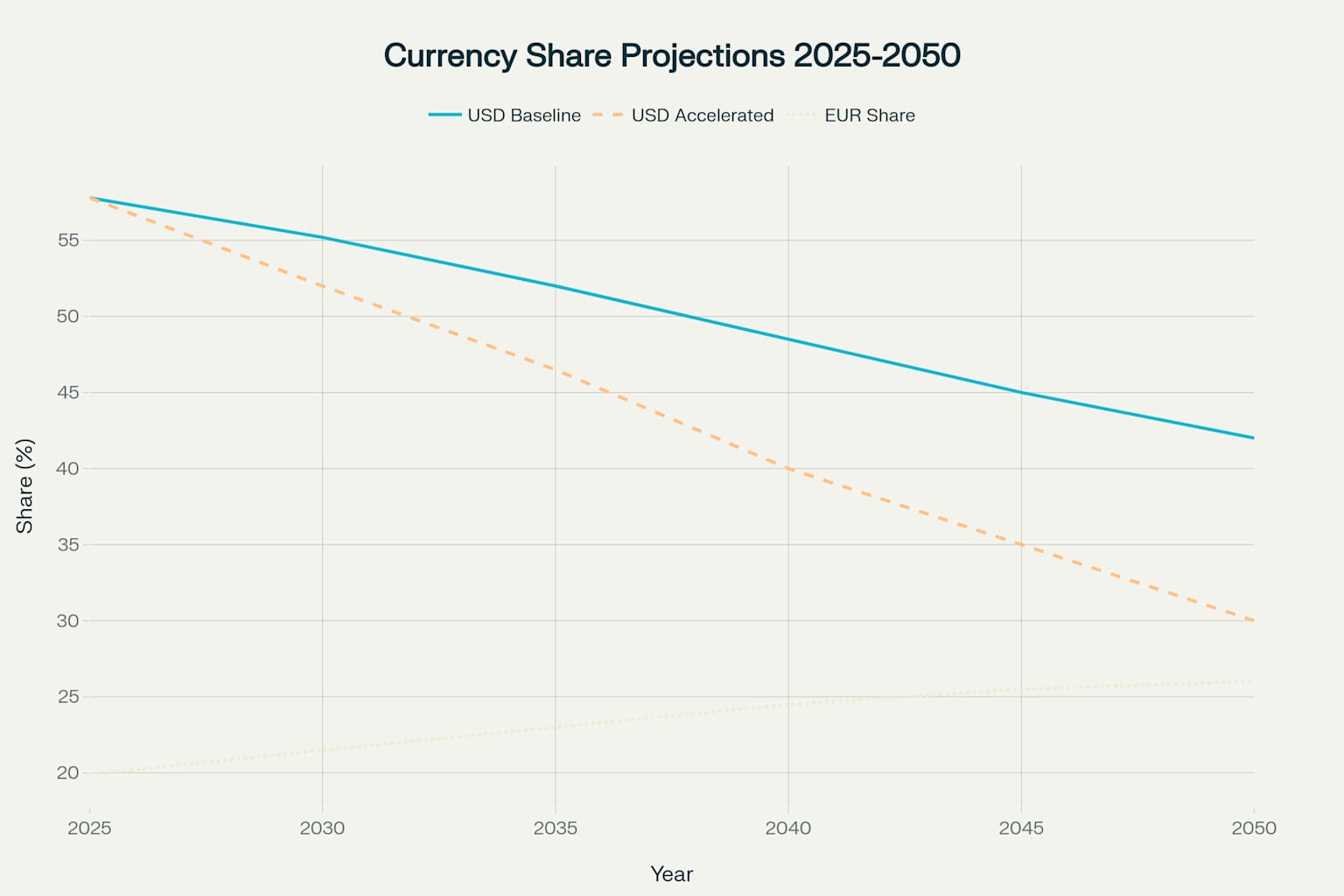
Mathematical models based on current trends reveal two potential scenarios for dollar decline. Under a baseline scenario of gradual diversification, the dollar’s reserve share falls to 42% by 2050. However, an accelerated decline driven by geopolitical fragmentation and continued fiscal recklessness could see the dollar’s share plummet to just 30%.
The emergence of alternative payment systems reinforces this trajectory. China’s mBridge CBDC platform, connecting central banks across Asia and the Middle East, processes cross-border payments without dollar intermediation. The yuan now comprises 53.6% of foreign currency trading on Moscow’s exchange, displacing the dollar entirely. These are not isolated incidents but components of a systematic de-dollarization infrastructure.
Academic research confirms that currency dominance is not permanent. The “dominant currency paradigm” shows that network effects can rapidly shift when confidence erodes. Historical precedent supports this: the pound sterling maintained reserve currency status until the 1940s despite Britain’s relative economic decline beginning in the 1870s, demonstrating that monetary dominance can persist until a sudden collapse.
Acknowledging and Refuting the Skeptics
Critics argue that no viable alternative exists to replace the dollar’s global role. They point to the depth of U.S. Treasury markets, the size of the American economy, and the lack of full convertibility for the Chinese yuan. This argument, while superficially compelling, fundamentally misunderstands the nature of monetary transitions.
The skeptics’ position crumbles under scrutiny. First, reserve currency status doesn’t require a single replacement—it can fragment across multiple currencies, as our projections demonstrate. The euro, yuan, yen, and gold can collectively absorb dollar outflows without any single currency achieving dominance. Second, the U.S. Treasury market’s depth becomes irrelevant if foreign central banks actively reduce their holdings, as current data clearly shows. Third, the dollar’s current funding costs of 4.5% far exceed alternatives like German bunds at 2.5% or Chinese bonds under 2%, undermining claims of American exceptionalism.
Most damaging to the skeptics’ case is their failure to recognize that reserve currency status depends on confidence, not just economic metrics. The Triffin dilemma—the structural contradiction between domestic and international monetary policies—has finally reached its logical conclusion. America can no longer simultaneously maintain domestic fiscal profligacy and international monetary credibility.
The weaponization argument alone demolishes the skeptics’ position. When 70% of central banks cite U.S. political instability as a reason to avoid dollar assets—more than double the previous year—the foundation of reserve currency status has already cracked. Trust, once lost, cannot be easily restored.
The Inevitable Decline: America’s Monetary Reckoning
The data is incontrovertible: America’s era of monetary dominance is ending. The combination of unsustainable fiscal policies, political weaponization of the dollar, and the emergence of viable alternatives has created a perfect storm that no amount of financial market depth can withstand. Central banks are not merely diversifying—they are systematically de-risking their exposure to American financial assets and political capriciousness.
The implications extend far beyond monetary policy. Dollar decline will force America to finance its deficits at market rates rather than through the “exorbitant privilege” of reserve currency status. This will either require savage fiscal adjustment or trigger an inflationary spiral that further undermines dollar credibility. The feedback loop is vicious and accelerating.
The twilight of the dollar is not a distant possibility—it is the observable reality unfolding in central bank boardrooms from Beijing to Brasília. America’s political and economic elites, drunk on decades of monetary privilege, have squandered the greatest economic advantage in modern history. The reckoning is no longer a question of if, but when.
As central banks complete their great unwinding, the United States will discover the harsh reality that no empire—financial or otherwise—lasts forever. The dollar’s decline is not just an economic phenomenon; it is the inevitable consequence of a nation that mistook privilege for permanence and power for prudence. The age of American monetary hegemony is ending not with conquest, but with abandonment.
Editor’s Note: This is an opinion column and represents the views of the author. It does not necessarily reflect the views of this publication.