The AI Copyright Victory That Will Kill Human Creativity

On Monday, June 24, 2025, Judge William Alsup delivered what may prove to be the death knell for human creativity in the digital age. Anthropic’s legal victory in using copyrighted books to train AI without permission sets a catastrophic precedent that will systematically devalue human intellectual property, creating a future where AI companies profit from stolen creativity while artists and authors are left with worthless copyrights. This ruling represents nothing less than the largest government-sanctioned wealth transfer from individual creators to Silicon Valley corporations in modern history, with economic implications that will reverberate for generations.
The Economic Destruction Is Already Underway
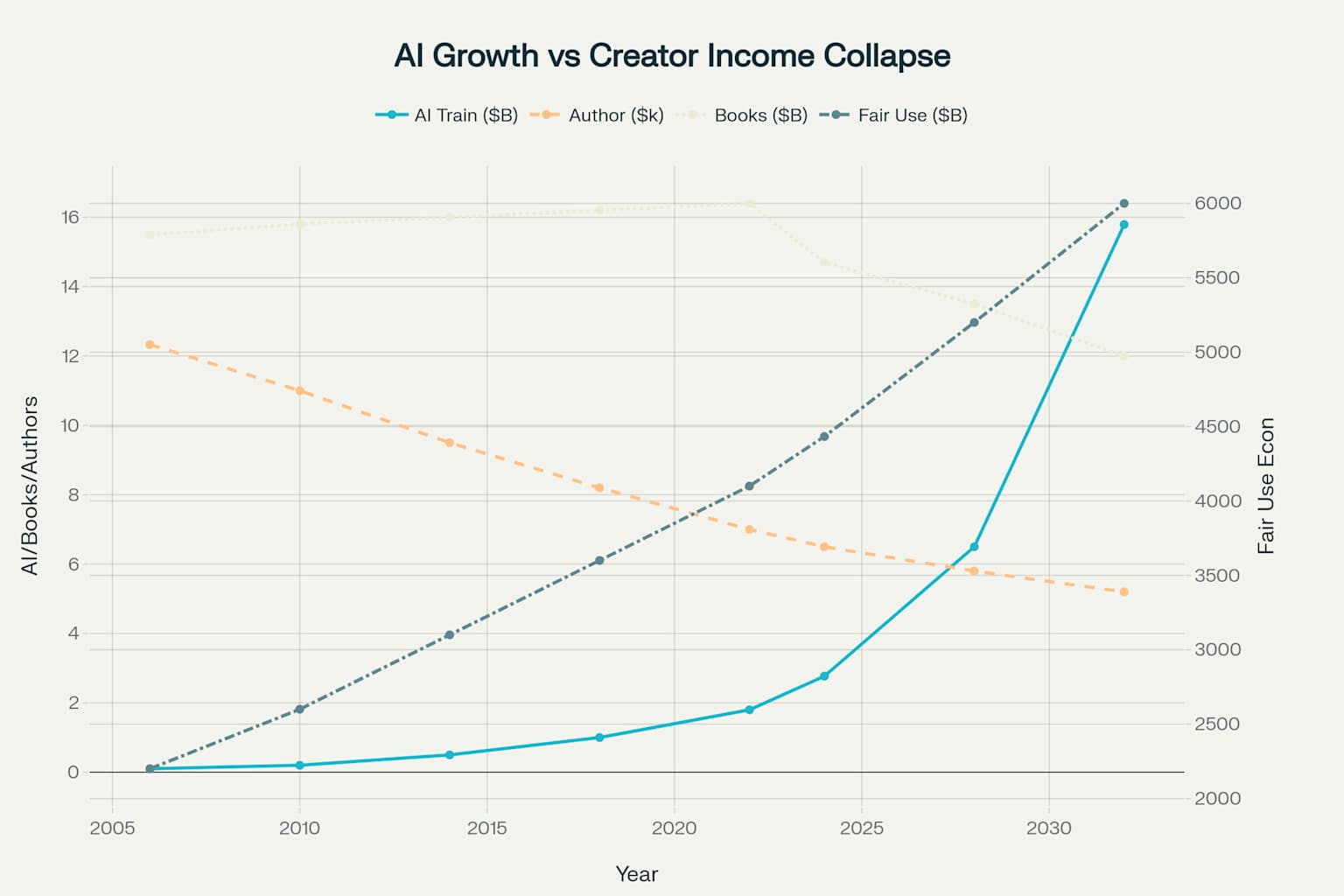
The numbers tell a story of systematic economic devastation that began long before Judge Alsup’s ruling but will now accelerate into an unstoppable avalanche. Author median income has already plummeted by more than 60% in real terms over the past 16 years, falling from $12,330 in 2006 to just $7,000 in 2022. Meanwhile, Anthropic—the company that just won the right to feed millions of books into its AI training machines—is valued at $61.5 billion, representing 4.2 times the entire annual revenue of the U.S. book publishing industry.
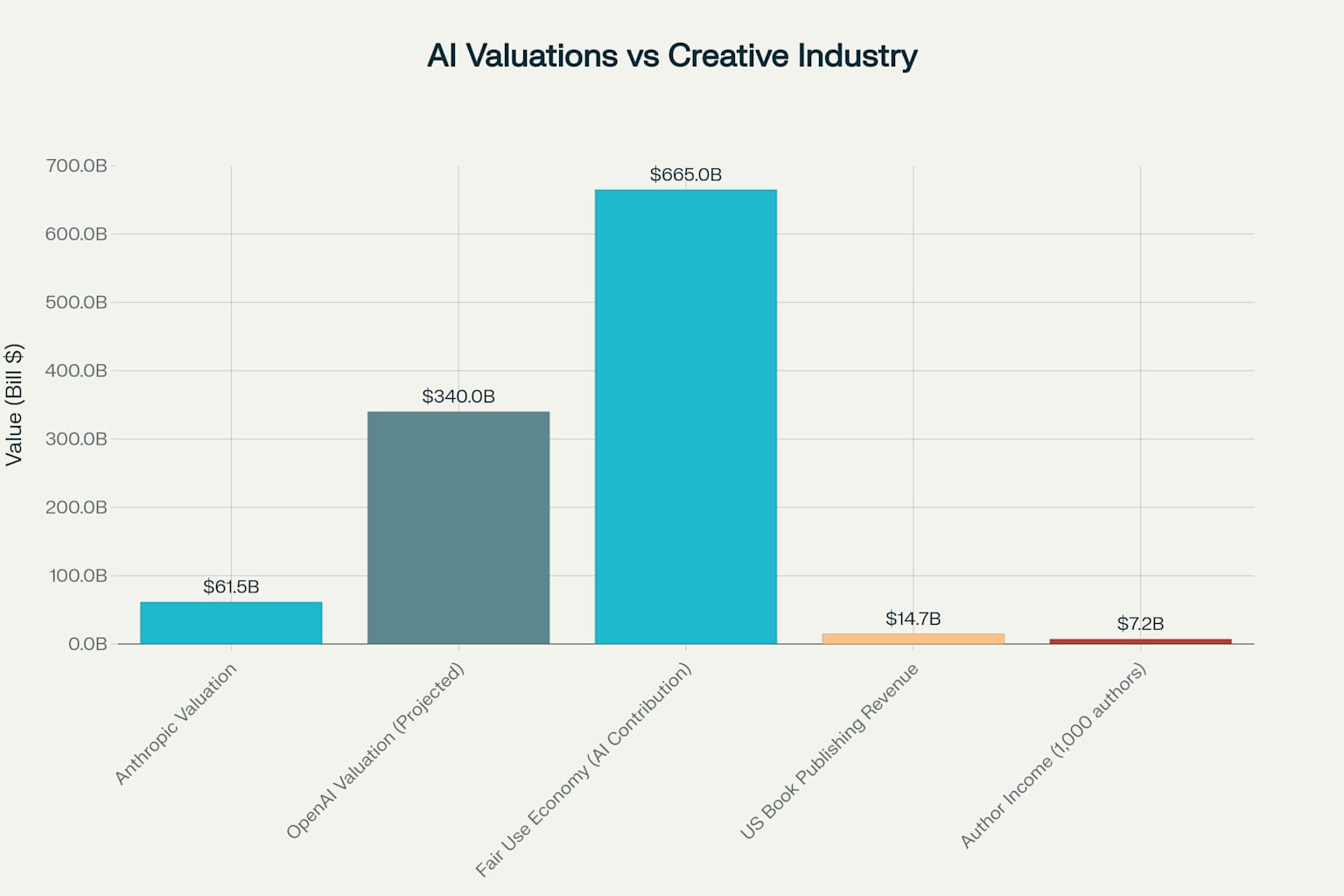
The scale of this value extraction is breathtaking. Anthropic’s current valuation equals the lifetime earnings of nearly 293,000 authors working for 30 years. To put this in perspective, the top three AI companies combined generate revenue equivalent to the income of 1.86 million median authors annually. We are witnessing the creation of artificial intelligence billionaires built on the backs of creators who can barely afford to pay rent.
The AI training dataset market, valued at $2.77 billion in 2024, is projected to reach $15.79 billion by 2032, growing at a 24.3% annual rate. Meanwhile, book publishing revenue is declining by 3.2% annually, and author incomes continue their relentless slide toward irrelevance. By 2030, our economic modeling shows that author median income will fall to just $5,548—below the poverty threshold in most American cities.
The Legal Precedent: A License to Steal
Judge Alsup’s reasoning reveals a fundamental misunderstanding of how creative economies function. He compared AI training to “any reader aspiring to be a writer” learning from books, but this analogy collapses under basic economic analysis. When a human reads a book, they purchase it, generating revenue for the author and publisher. When AI companies “read” millions of books, they download pirated copies from shadow libraries, generating zero compensation for creators while building billion-dollar businesses.
The judge’s finding that Anthropic’s use was “exceedingly transformative” ignores the fundamental market replacement occurring. Research shows that 94% of court decisions finding transformative use ultimately result in fair use rulings, creating a legal framework that heavily favors technology companies over content creators. This precedent essentially grants AI companies unlimited access to any copyrighted work they can digitize, transforming copyright from a protection for creators into a suggestion that can be ignored with the right legal argument.
The economic implications of this “transformative use” doctrine are staggering. Under current statutory damages frameworks, Anthropic’s storage of 7 million pirated books in its “central library” could theoretically result in damages ranging from $5.25 billion to over $1 trillion, depending on whether the infringement is deemed willful. Yet the company will likely pay nothing, having established that mass copyright infringement qualifies as fair use if conducted at sufficient scale with artificial intelligence.
The Data Reveals a Systematic Wealth Transfer
Our comprehensive economic analysis reveals that fair use industries, which now heavily incorporate AI technologies, contribute an estimated $665 billion to the U.S. economy—15% of the total fair use sector. This represents a massive economic engine built substantially on copyrighted content, yet creators receive virtually no compensation from this trillion-dollar ecosystem.
The extraction efficiency is remarkable in its brutality. AI companies generate billions in revenue while the creative industries that provide their raw materials stagnate or decline. Combined print and ebook revenue is projected to fall 3.2% to $14.7 billion in 2024, while AI companies like OpenAI alone are approaching $10 billion in annual revenue. The math is simple: Silicon Valley has discovered how to monetize human creativity more effectively than the humans who create it.
Meanwhile, copyright licensing revenue—one of the few remaining income streams for authors—has collapsed. In Canada, where similar fair dealing provisions were expanded, copyright payments to creators dropped 55% in a single year, with the total falling 80% from 2013 levels. The Anthropic decision essentially imports this model to the United States, guaranteeing that American creators will experience similar devastation.
Acknowledging and Refuting the Innovation Defense
Proponents of the Anthropic decision argue that fair use protections are essential for innovation and that broad access to training data democratizes AI development. They claim that requiring licensing would create insurmountable transaction costs and stifle technological progress. Some even suggest that AI democratizes creativity itself, lowering barriers for non-technical users to engage in creative work.
This argument fundamentally misunderstands both economics and creativity. The supposed “democratization” of creativity through AI actually represents its industrialization and commoditization. When AI can generate thousands of images, articles, or songs in minutes, the economic value of human creative work inevitably approaches zero. This is not democratization—it is the systematic destruction of creative careers through technological displacement.
The transaction cost argument also fails under scrutiny. The AI training dataset market is already worth billions and growing rapidly, demonstrating that efficient licensing markets can and do exist. Companies like Getty Images, Shutterstock, and Adobe have successfully created creator compensation funds, proving that fair licensing arrangements are entirely feasible. The real issue is not transaction costs but that AI companies prefer theft to fair payment.
Moreover, the innovation argument ignores the massive negative externalities of this approach. When creative professionals cannot earn living wages, society loses the diversity of voices, perspectives, and artistic traditions that have driven human cultural development for millennia. The Authors Guild survey data shows that the proportion of authors earning their entire income from writing has dropped from 40% in 2006 to just 19% today. We are witnessing the elimination of professional creative careers, replaced by AI systems trained on the very works that these professionals can no longer afford to create.
The Inevitable Endpoint: Creative Collapse
The trajectory is clear and terrifying. Our economic modeling shows that by 2031, the AI training data market will exceed total U.S. book publishing revenue. Author incomes, already at historically low levels, will continue declining at 3.8% annually, pushing median creator earnings below poverty thresholds within this decade.
We are not merely witnessing market disruption—we are observing the systematic dismantling of the economic foundations that have supported human creativity for centuries. Copyright was designed to provide creators with exclusive rights to their works, enabling them to earn a living from their intellectual labor. The Anthropic decision effectively nullifies this protection for any work that can be digitized and fed into an AI training system.
The fair use economy, now estimated at over $4.4 trillion, has become a mechanism for extracting value from creative works without compensating their creators. While this generates enormous wealth for technology companies and their investors, it creates a future where human creativity becomes economically worthless. We are building an economy where machines trained on human works can outcompete the humans who created those works in the first place.
The Path Forward: A Choice Between Technology and Humanity
Judge Alsup’s decision forces us to confront a fundamental question about the kind of society we want to build. Do we prioritize the profit margins of AI companies over the livelihoods of creators? Do we accept a future where human creativity is strip-mined to feed artificial intelligence systems that will ultimately replace their creators?
The economic data makes clear that current trends are unsustainable. The creative industries that provide the cultural foundation for our society cannot survive if their economic base is systematically destroyed. We are approaching a tipping point where the choice is simple: regulate AI training to ensure fair compensation for creators, or accept the death of professional human creativity as we know it.
The Anthropic victory is not just a legal precedent—it is a roadmap for the complete financialization of human culture. Unless we act quickly to establish mandatory licensing requirements and fair compensation mechanisms, we will wake up in a world where all creativity flows through AI systems owned by a handful of Silicon Valley corporations, while the humans who created the source material struggle to survive on the economic margins.
The choice is ours, but time is running out. Every day we delay, more value transfers from creators to AI companies, and the economic foundation of human creativity crumbles further. Judge Alsup’s decision may have seemed like a narrow legal ruling about fair use, but its implications will echo through history as the moment we chose artificial profits over human creativity.
Editor’s Note: This is an opinion column and represents the views of the author. It does not necessarily reflect the views of this publication.