Vietnam’s Economic Miracle: The ASEAN Strategy That’s Defying Global Slowdown

Vietnam’s economy stands as a remarkable anomaly in a world grappling with the most severe growth deceleration in decades. While the World Bank projects the 2020s to become the weakest decade for global economic expansion since the 1960s, Vietnam continues to deliver robust growth rates that outpace both developed and emerging market peers. This economic resilience stems from a sophisticated integration strategy within ASEAN, manufacturing competitiveness, and structural reforms that have positioned the Southeast Asian nation as a critical node in evolving global supply chains.
The contrast between Vietnam’s trajectory and global economic trends reveals fundamental shifts in international trade patterns and regional economic integration. As traditional economic powerhouses face mounting challenges from trade tensions, policy uncertainty, and demographic pressures, Vietnam’s strategic positioning within ASEAN has created unique advantages that insulate the economy from broader global headwinds.
Global Economic Context and the Unprecedented Slowdown
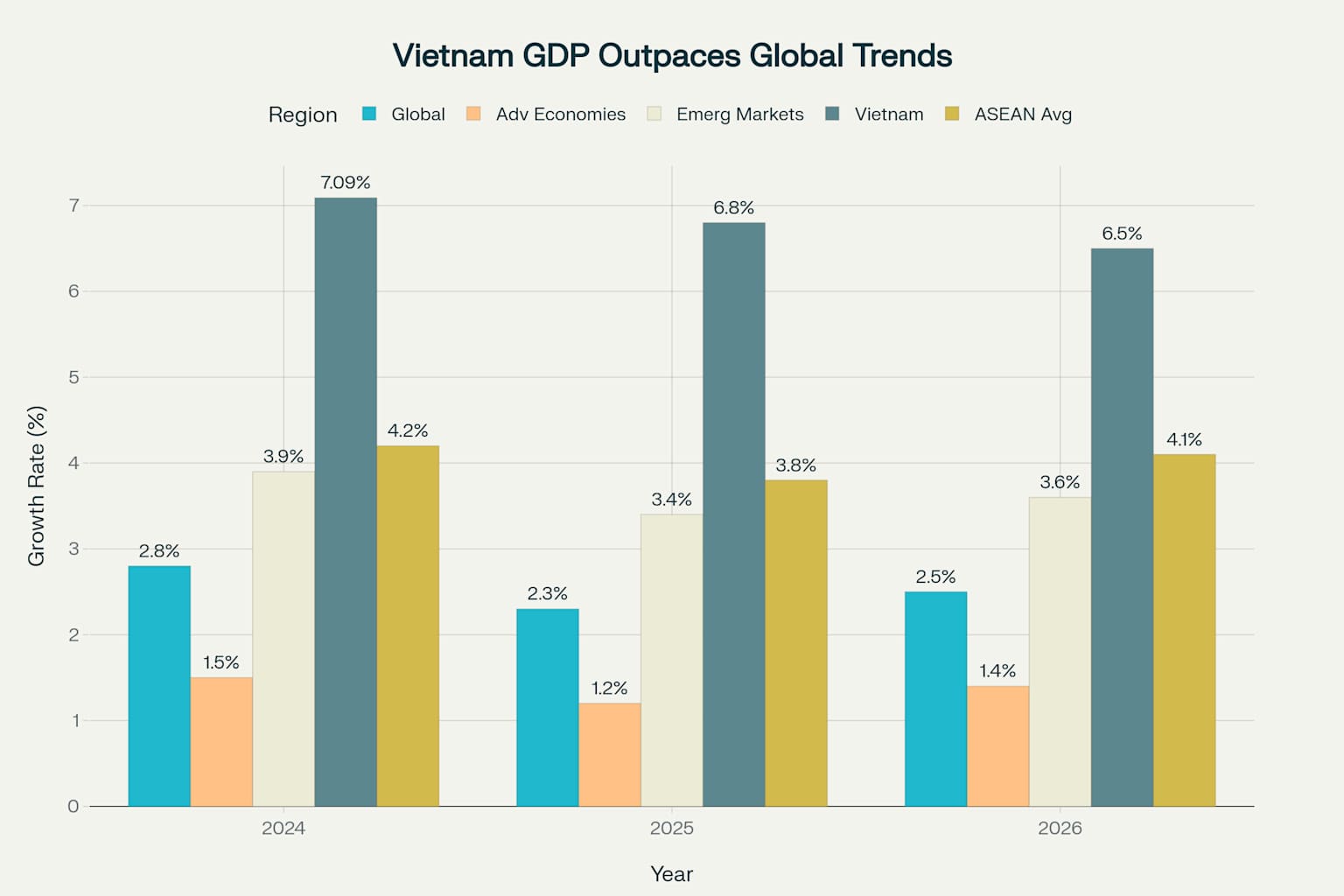
The latest global economic outlook delivers a sobering assessment of the international economic landscape, forecasting global growth to decelerate to 2.3 percent in 2025, down from 2.7 percent projected earlier in the year. This downward revision reflects the cumulative impact of escalating trade tensions, policy uncertainty, and structural challenges facing major economies. Average global growth in the first seven years of the 2020s is set to register the weakest performance since the 1960s, with nearly 70 percent of all economies experiencing downgraded growth forecasts.
The primary catalyst for this global deceleration stems from trade policy disruptions, particularly the implementation of universal tariffs and retaliatory measures that have pushed global trade growth to an anticipated 1.8 percent in 2025. Advanced economies face particularly acute challenges, with growth projected at just 1.2 percent in 2025, while emerging markets and developing economies are expected to expand by only 3.4 percent. The United States, despite its economic strength, faces a sharp deceleration to 1.4 percent growth in 2025, nearly half the 2.8 percent recorded in 2024.
This deteriorating global environment creates significant headwinds for export-dependent economies, yet Vietnam continues to demonstrate exceptional resilience. The country’s ability to maintain growth momentum while global trade contracts represents a fundamental shift in economic geography and supply chain dynamics.
Vietnam’s Economic Performance Analysis
Vietnam’s economic trajectory defies conventional expectations for emerging market performance during global slowdowns. The country achieved GDP growth of 7.09 percent in 2024, making it the fastest-growing economy among ASEAN nations and significantly outperforming both regional and global averages. Projections indicate Vietnam will maintain robust expansion at 6.8 percent in 2025, nearly three times the global average.
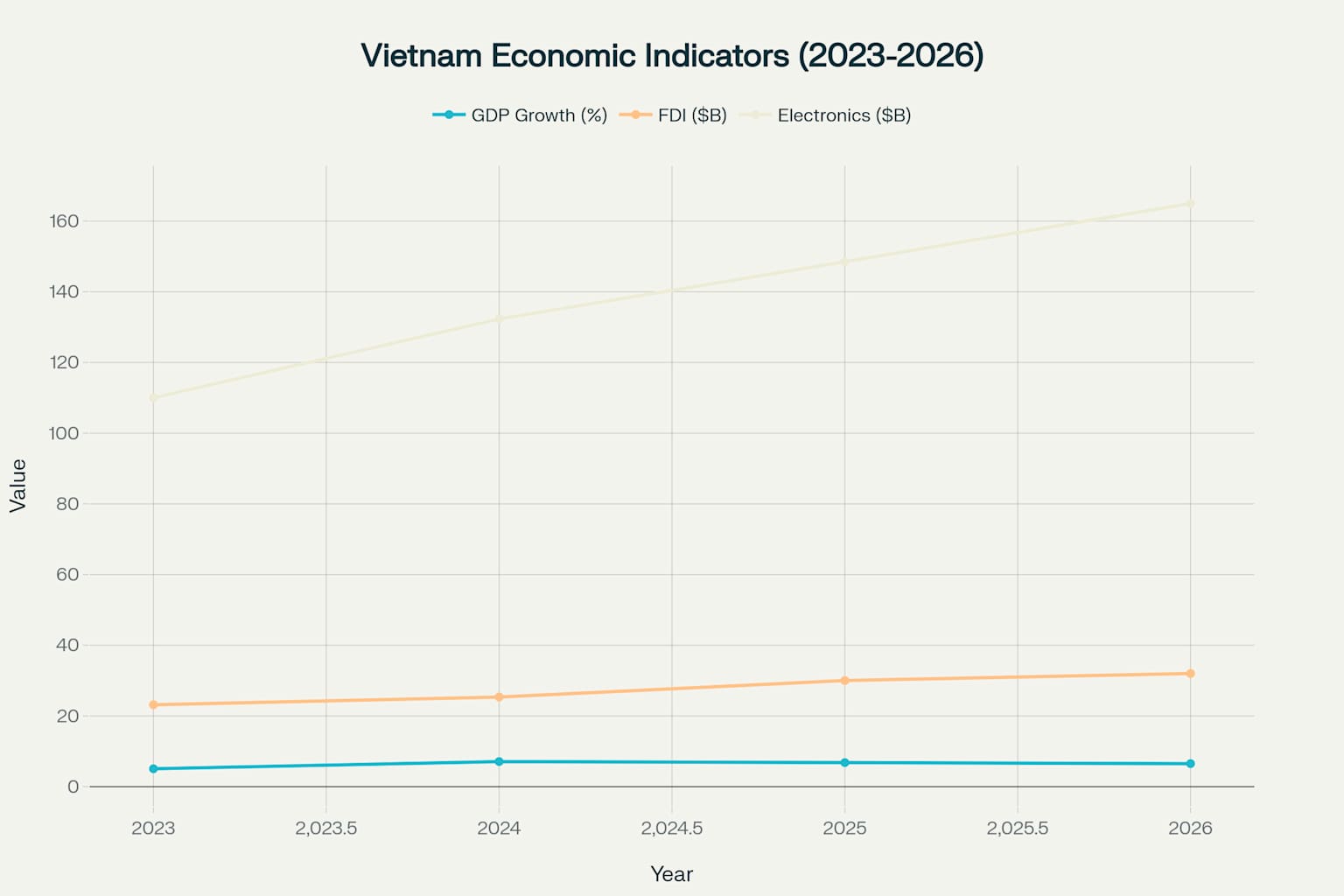
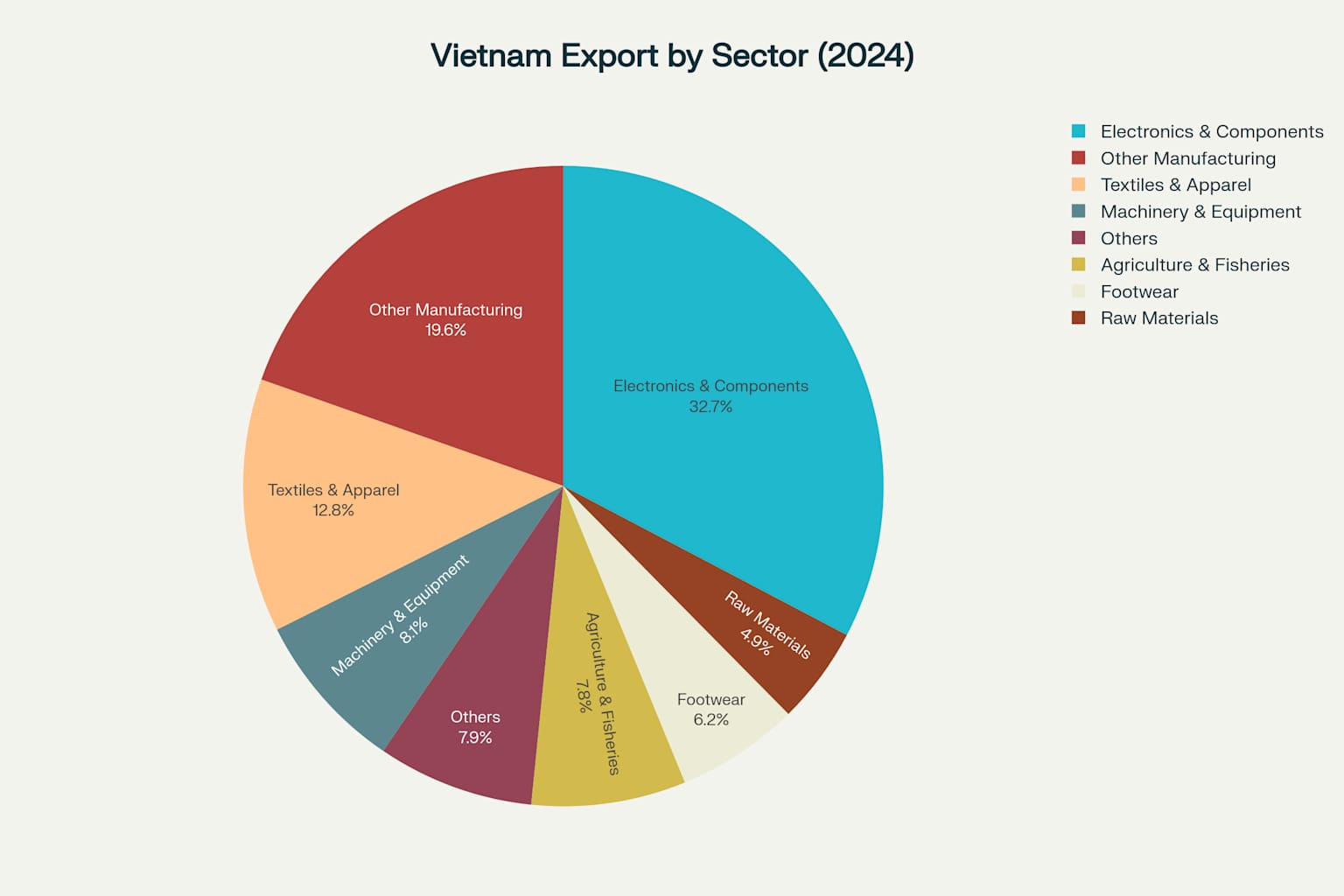
This growth performance reflects broad-based economic strength across multiple sectors. The manufacturing and processing sector, which accounts for 81.4 percent of foreign direct investment disbursements, continues to drive economic expansion through export growth and technological upgrading. The electronics industry alone generated export revenues of $132.3 billion in 2024, representing 32.7 percent of total exports and demonstrating Vietnam’s successful transition toward higher value-added production.
Foreign direct investment flows provide additional evidence of Vietnam’s economic momentum. FDI disbursements reached a record $25.35 billion in 2024, representing 9.4 percent growth from the previous year. Singapore leads international investors with commitments totaling $84.3 billion across 3,946 projects, followed by Thailand and Malaysia with substantial investment portfolios. The manufacturing and processing sector attracted $20.6 billion in FDI, while high-technology segments including semiconductors, artificial intelligence, and data centers represent emerging investment priorities.
Vietnam’s stock market performance reinforces the underlying economic strength. The VN-Index gained 8.67 percent in May 2025, reaching a three-year high and marking the strongest monthly performance since July 2023. This market rally reflects investor confidence in Vietnam’s trade negotiations with the United States, infrastructure development progress, and corporate earnings growth.
The ASEAN Strategic Advantage
Vietnam’s integration within ASEAN provides a critical foundation for economic resilience and growth sustainability. Total trade between Vietnam and ASEAN countries reached $83.6 billion in 2024, establishing the regional bloc as Vietnam’s fourth-largest export market and third-largest import source. This deep economic integration creates multiple channels for growth diversification and risk mitigation.
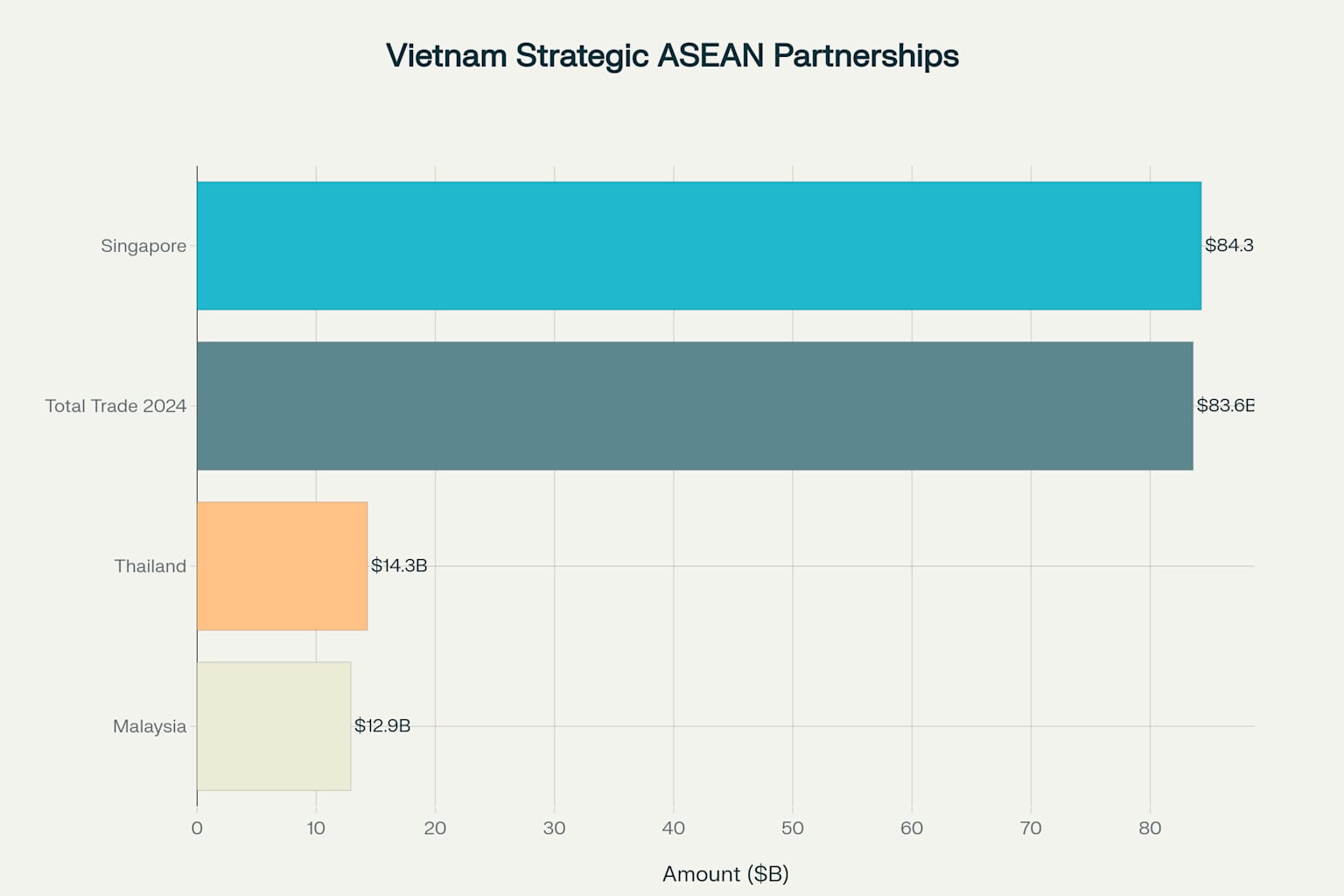
The strategic partnership extends beyond trade to encompass comprehensive investment relationships. ASEAN countries invested $9.52 billion in Vietnam during the first eleven months of 2024, representing 51.1 percent growth compared to the previous year. Singapore’s dominant position reflects its role as a regional financial hub and gateway for international capital, while Thai and Malaysian investments focus on manufacturing, energy, and infrastructure development.
Vietnam’s reciprocal investments in ASEAN markets demonstrate the bilateral nature of regional integration. The country has deployed nearly $12.1 billion across 871 projects in fellow ASEAN nations, primarily in Laos, Cambodia, Myanmar, Malaysia, and Singapore. These investments position Vietnamese companies to capture opportunities in emerging markets while diversifying revenue sources beyond traditional export destinations.
The institutional framework supporting ASEAN integration provides additional advantages through trade facilitation, regulatory harmonization, and dispute resolution mechanisms. Vietnam’s participation in the ASEAN Economic Community enables preferential market access, streamlined customs procedures, and coordinated policy responses to external shocks. This regional foundation complements Vietnam’s broader network of free trade agreements, including the Comprehensive and Progressive Agreement for Trans-Pacific Partnership and the European Union-Vietnam Free Trade Agreement.
Manufacturing and Export Competitiveness
Vietnam’s manufacturing sector embodies the country’s successful transition from low-cost assembly to sophisticated production capabilities. The electronics and technology sector exemplifies this transformation, with export values reaching $132.3 billion in 2024 and projected to grow 12.3 percent to $148.5 billion in 2025. Major international corporations including Samsung, Foxconn, and Apple suppliers have established significant manufacturing operations, contributing to Vietnam’s position as a critical node in global technology supply chains.
The “China Plus One” strategy has accelerated Vietnam’s manufacturing competitiveness by attracting companies seeking supply chain diversification. Rising labor costs in China, coupled with trade tensions and geopolitical uncertainties, have driven manufacturers to establish alternative production bases. Vietnam’s geographical proximity to China, competitive labor costs, and improving infrastructure make it an attractive destination for this manufacturing migration.
Export diversification demonstrates Vietnam’s manufacturing sophistication. While electronics dominate at 32.7 percent of total exports, significant contributions from textiles and apparel (12.8 percent), machinery and equipment (8.1 percent), and agriculture and fisheries (7.8 percent) provide economic stability. This diversified export base reduces vulnerability to sector-specific shocks while enabling Vietnam to capture opportunities across multiple global markets.
Manufacturing productivity improvements reflect ongoing technological upgrading and skills development. Government initiatives promoting automation, digitization, and workforce training have enhanced the sector’s competitiveness. The focus on high-technology industries, including semiconductors and artificial intelligence, positions Vietnam to capture higher value-added segments of global production networks.
Structural Drivers of Resilience
Vietnam’s economic resilience stems from fundamental structural advantages that differentiate it from other emerging markets. The demographic dividend represents a critical long-term growth driver, with 67 percent of the population in working age and the favorable age structure expected to persist until 2042. This 36-year demographic window provides sustained labor force growth and supports domestic consumption expansion.
The country’s institutional framework has undergone significant modernization to support sustainable growth. Resolution 66-NQ/TW on legal framework improvements aims to create more transparent and responsive regulatory environments. These institutional reforms complement infrastructure development priorities, including the North-South high-speed railway and Long Thanh International Airport, which enhance regional connectivity and competitiveness.
Macroeconomic stability provides additional resilience against external shocks. Inflation remains well-controlled below the 4.5 percent target, while the current account balance shows steady improvement. The State Bank of Vietnam’s monetary policy framework has demonstrated effectiveness in managing inflation dynamics and maintaining financial stability. Foreign exchange reserves have increased following improved external conditions and positive investor confidence.
Policy consistency and strategic planning reinforce long-term growth prospects. The government’s commitment to achieving 8 percent growth in 2025 and double-digit expansion in subsequent years reflects ambitious but achievable targets given current economic momentum. These growth objectives are supported by comprehensive reform programs addressing infrastructure, human capital, and institutional capacity.
Policy Framework and Infrastructure Investment
Vietnam’s policy framework demonstrates sophisticated understanding of the requirements for sustained economic development. The government has increased infrastructure spending targets from 6 percent to 7 percent of GDP in 2025, representing nearly $36 billion in planned investments. This infrastructure acceleration addresses connectivity bottlenecks while supporting the ambitious GDP growth targets.
Major infrastructure projects include the $67 billion North-South high-speed railway, the $8 billion Lao Cai-Hanoi-Hai Phong railway, and completion of Ho Chi Minh City’s metro system. These investments enhance domestic connectivity while improving links to regional and global markets. The infrastructure program also includes strategic projects such as beltways around major cities and expressway networks that reduce transportation costs and improve logistics efficiency.
Fiscal policy supports growth through targeted interventions and structural reforms. The 2025 state budget totals nearly VND 2.55 quadrillion, representing 20.3 percent growth from the previous year. Public investment spending reaches a record VND 790 trillion, up 16.7 percent from 2024. Tax relief measures including VAT reductions and land rental deferrals provide additional stimulus to businesses and consumers.
The policy framework addresses long-term competitiveness through human capital development and innovation promotion. Science and technology initiatives emphasize digital transformation and high-technology applications in production. Private sector development receives priority through startup support and improved ease of doing business measures. These comprehensive policy approaches create enabling conditions for sustained high-quality growth.
Conclusion
Vietnam’s economic performance represents a compelling case study in successful development strategy execution during challenging global conditions. The country’s ability to maintain GDP growth rates three times the global average while traditional economic powers face deceleration reflects sophisticated policy coordination, strategic regional integration, and successful structural transformation. The ASEAN framework provides crucial foundations for trade diversification, investment attraction, and risk mitigation that insulate Vietnam from broader global headwinds.
The convergence of favorable structural factors creates sustainable advantages for continued growth. The demographic dividend extends through 2042, providing decades of labor force expansion and domestic market growth. Manufacturing competitiveness positions Vietnam as a preferred destination for supply chain diversification and technology transfer. Infrastructure investments and institutional reforms address development bottlenecks while enhancing long-term productivity.
Vietnam’s trajectory demonstrates that emerging markets can achieve exceptional performance through strategic positioning and policy execution, even during periods of global economic stress. The country’s success offers insights for other developing economies seeking to navigate an increasingly complex international environment. As global growth patterns shift toward Asia-Pacific dynamism, Vietnam’s integration within ASEAN and its manufacturing capabilities position it to capture disproportionate benefits from these structural trends.
The implications extend beyond Vietnam to encompass broader questions about regional economic integration, supply chain resilience, and development strategy effectiveness. Vietnam’s experience suggests that countries combining demographic advantages, institutional capacity, and strategic regional partnerships can achieve sustained high growth despite global headwinds. This model provides valuable lessons for policymakers and investors navigating an era of heightened economic uncertainty and structural transformation.