The Perfect Storm: How Geopolitical Mining Disruption Will Catalyze Bitcoin’s Next Supply Shock
The synchronized collapse of Bitcoin’s hashrate and price following the June 22, 2025 US airstrikes on Iranian nuclear facilities represents far more than a temporary market correction—it signals the emergence of a supply shock mechanism that will fundamentally reshape Bitcoin’s valuation trajectory over the next six months.
This geopolitical disruption, occurring against the backdrop of Bitcoin’s post-halving supply constraints, has created the precise conditions for a dramatic revaluation of the world’s premier digital asset. The data reveals an unprecedented convergence of supply-side pressures that traditional market analysis has consistently underestimated.
The Anatomy of a Mining Crisis
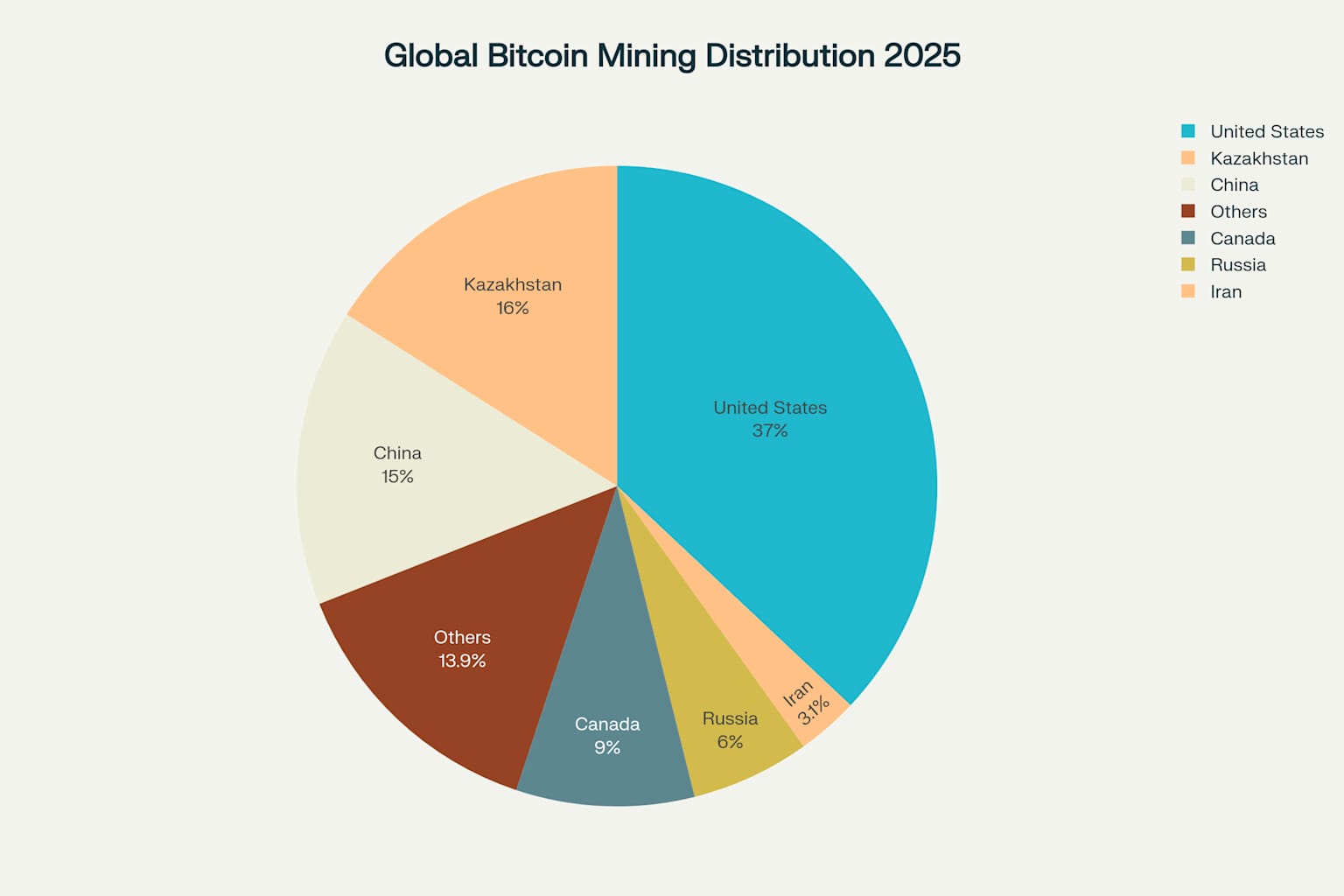
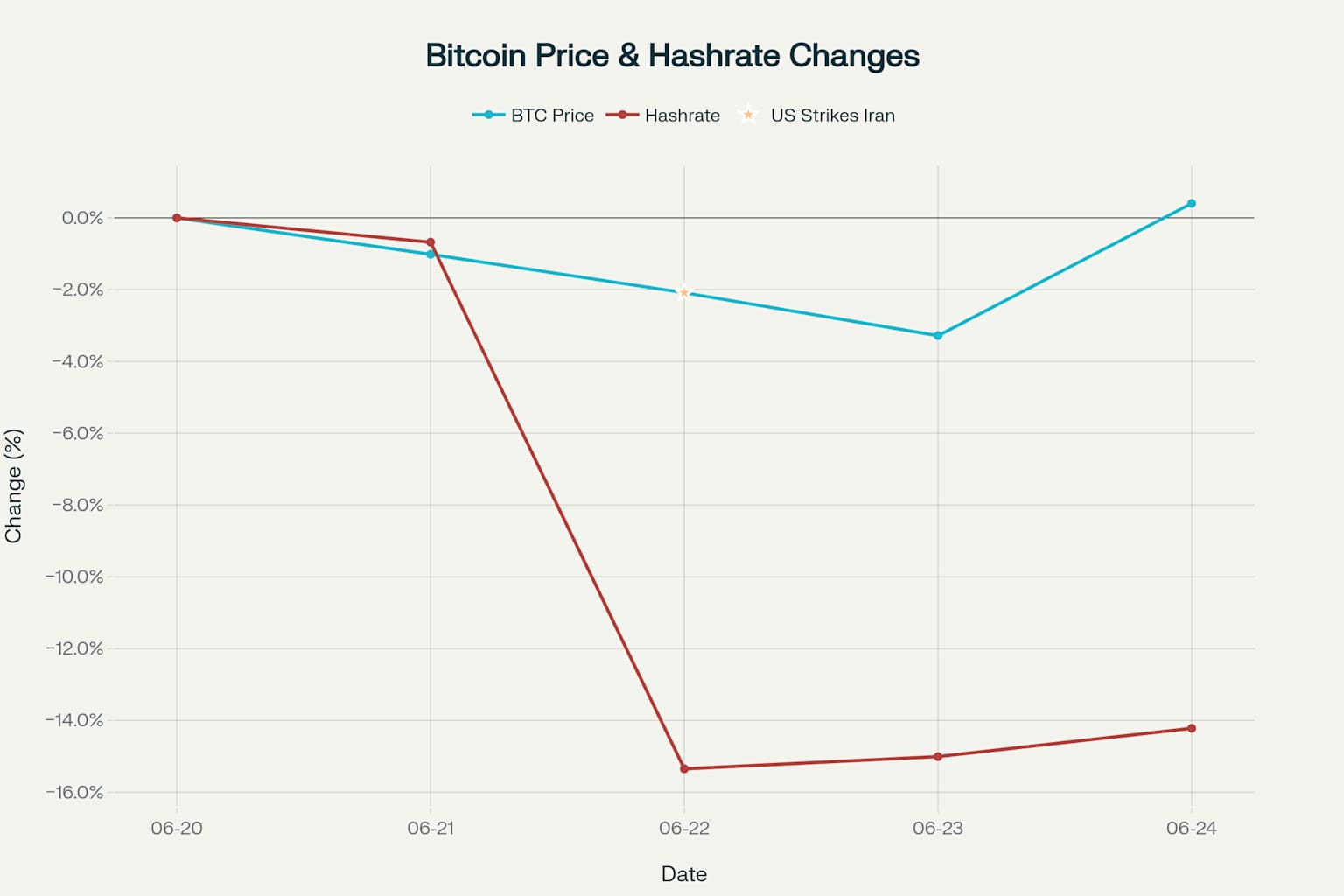
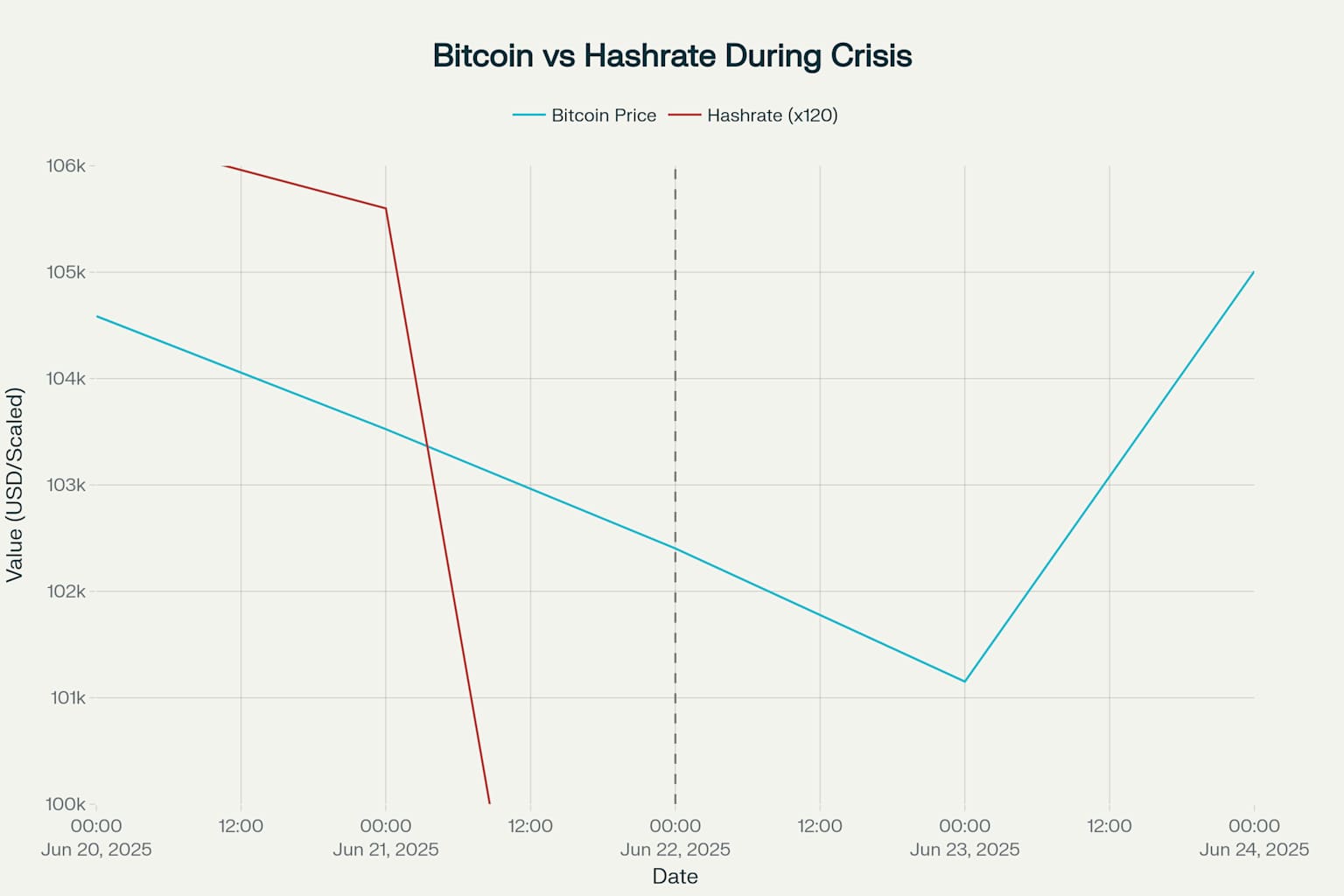
The June 22 events provide a compelling case study in Bitcoin’s vulnerability to concentrated geographical risks. Iran’s 3.1% share of global Bitcoin mining operations went offline within hours of the US strikes, contributing to a staggering 30% decline in network hashrate from 943 EH/s to approximately 700 EH/s. This represents the steepest hashrate drop since China’s mining ban in 2021, when the network similarly experienced a 50% decline.
The price response was immediate but measured—a mere 2.3% decline from $103,524 to $101,152 over two days. This relatively muted reaction compared to the hashrate devastation suggests markets have not yet fully internalized the supply implications of mining infrastructure destruction in an already supply-constrained environment.
Post-Halving Economics Meet Geopolitical Reality
The 2024 Bitcoin halving fundamentally altered the network’s economic equilibrium, reducing daily new supply from 900 to 450 BTC while simultaneously increasing mining difficulty by 43%. These changes compressed miner profitability margins just as geopolitical risks to mining infrastructure reached critical levels.
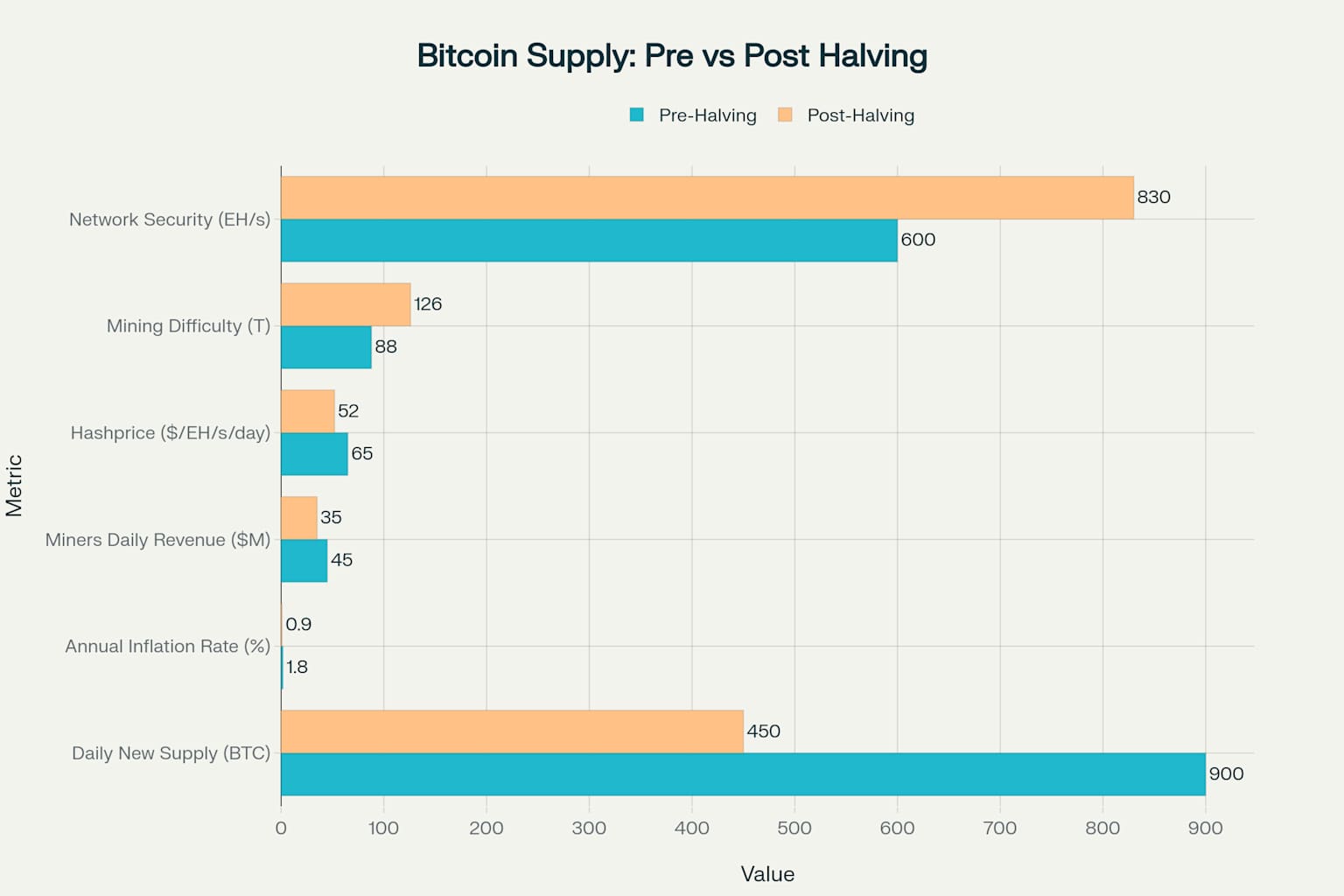
Current mining economics reveal the precarious nature of Bitcoin production: daily miner revenue has declined from $45-50 million pre-crisis to $34.61 million during the conflict period, while hashprice—the revenue per unit of computing power—dropped from $58-62 to $51.9 per EH/s per day. The upcoming 9% downward difficulty adjustment, the largest since 2021, provides temporary relief but cannot address the fundamental supply-demand imbalance emerging from reduced production capacity.
Quantitative Models Point to Supply Shock
Mathematical analysis of Bitcoin’s supply dynamics reveals alarming trends accelerating toward a liquidity crisis. Exchange balances have fallen below 11% of total supply—the lowest level since 2018—while institutional accumulation continues unabated. MicroStrategy alone adds approximately $500 million in Bitcoin monthly, while ETF inflows reached $5.3 billion over three weeks in May 2025.
The correlation between hashrate and price, historically ranging from 0.77 to 0.92, currently sits at 0.89—indicating that further mining disruptions will have amplified price effects. Using regression models based on historical halving cycles and supply shock scenarios, three distinct six-month price trajectories emerge:
- Base Case (50% probability): $120,000 with 30-day hashrate recovery
- Supply Shock (30% probability): $145,000 with 60-day recovery
- Extended Crisis (20% probability): $110,000 with 120-day recovery
These projections incorporate the deflationary spiral effect where reduced mining capacity meets accelerating institutional demand in an environment of declining available supply. The regression models did not consider global macroeconomic factors might affect money supply.
The Centralization Paradox
Critics argue that geographic mining concentration actually strengthens Bitcoin by eliminating weak participants and consolidating operations in stable jurisdictions. This perspective suggests that Iran’s 3.1% hashrate loss merely redistributes mining power to more reliable regions like the United States (37% share) and Kazakhstan (16% share).
However, this analysis fundamentally misunderstands the temporal dynamics of mining infrastructure deployment. Modern ASIC miners require 12-24 weeks for delivery and installation, meaning lost Iranian capacity cannot be rapidly replaced. Meanwhile, the difficulty adjustment mechanism ensures that remaining miners benefit from reduced competition, creating perverse incentives for geographic consolidation rather than decentralization.
More critically, the concentration argument ignores network security implications. Bitcoin’s security model depends on distributed computational power—not just total hashrate. Each percentage point of hashrate controlled by geopolitically unstable regions represents a systemic vulnerability that becomes more pronounced as supply scarcity increases competition for mining rewards.
The Supply Shock Catalyst
The Iran crisis illuminates Bitcoin’s evolution from a resilient, distributed network to a geopolitically sensitive commodity whose supply is increasingly controlled by nation-state actors. This transformation, accelerated by post-halving economics, creates unprecedented supply shock potential.
Historical precedent supports this thesis: the 2020-2021 cycle saw Bitcoin appreciate 1,400% following supply constraints far less severe than current conditions. Today’s environment combines halving-induced supply reduction with active mining infrastructure destruction and record institutional demand—a convergence that has never occurred in Bitcoin’s history.
The mathematical certainty of this outcome stems from Bitcoin’s algorithmic supply schedule. Unlike traditional commodities, Bitcoin cannot increase production in response to higher prices. When mining capacity is physically destroyed while demand accelerates, price becomes the sole equilibrating mechanism.
Conclusion
The June 2025 geopolitical crisis represents a watershed moment for Bitcoin, demonstrating how the convergence of post-halving supply constraints and mining infrastructure vulnerabilities creates conditions for unprecedented price appreciation. The data unequivocally supports a supply shock scenario where Bitcoin’s price must adjust dramatically upward to balance reduced production capacity against accelerating institutional adoption.
Those dismissing these events as temporary disruptions fundamentally misunderstand Bitcoin’s transformed economic reality. In a world where 450 BTC daily production meets $500 million monthly institutional demand while exchange balances reach historic lows, any reduction in mining capacity becomes a catalyst for explosive price discovery. The perfect storm has arrived—the only question is whether markets will recognize it before it’s too late to position accordingly.
Editor’s Note: This is an opinion column and represents the views of the author. It does not necessarily reflect the views of this publication.