Should NATO members be forced to boost defense spending to 5% of GDP?
NATO’s Trillion-Dollar Folly: Why the 5% Defense Spending Mandate Will Hollow Out Democracy
The specter of Russian aggression has prompted NATO Secretary General Mark Rutte and U.S. President Donald Trump to demand an unprecedented escalation in alliance defense spending—a staggering 5% of GDP target that would force most member nations to more than double their military budgets by 2035. While framed as essential for collective security, this misguided mandate represents a dangerous prioritization of military expansion over the social contract that underpins democratic legitimacy, threatening to bankrupt the very societies NATO purports to defend.
The Arithmetic of Absurdity
The scale of financial commitment demanded by NATO’s leadership defies rational budgetary planning and reveals the hollowness of their strategic thinking. Current NATO spending has already reached a record $1.3 trillion annually, with 23 of 32 members finally meeting the long-established 2% GDP threshold in 2024. Yet this achievement, representing years of gradual defense buildup following Russia’s 2022 invasion of Ukraine, apparently falls far short of alliance ambitions.
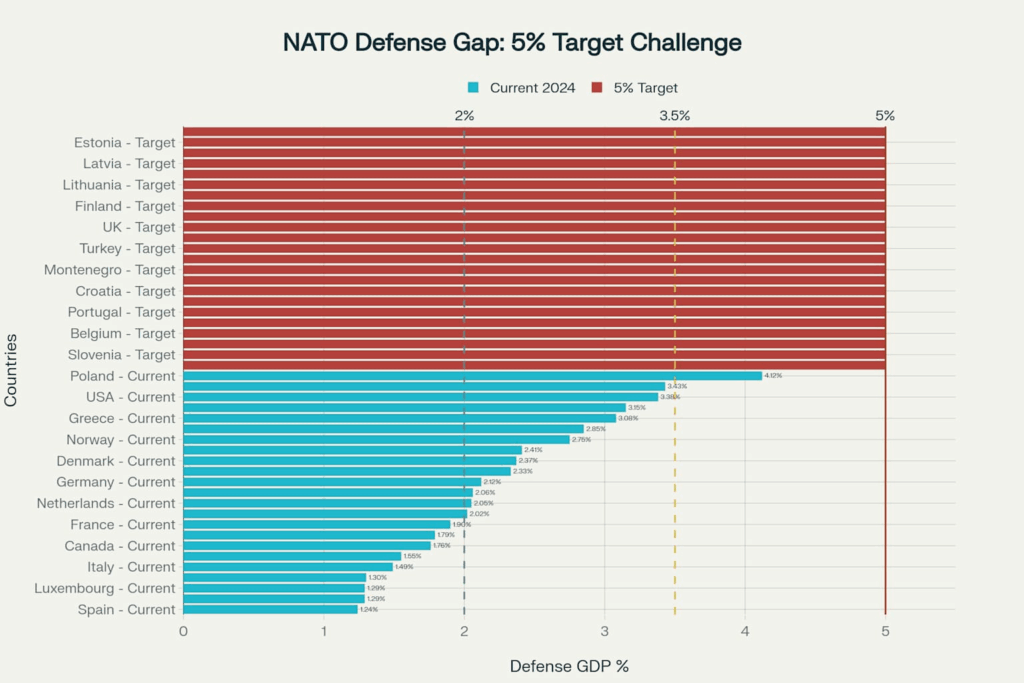
The proposed 5% target—comprising 3.5% for core military spending and 1.5% for security-related infrastructure—would require most NATO members to undertake budgetary gymnastics that border on fiscal impossibility. Only Poland currently meets the core 3.5% threshold at 4.12% of GDP, while countries like Spain, Italy, and Luxembourg would need to increase their defense spending by over 280%. For major European economies, this translates into hundreds of billions in additional annual expenditure that must be extracted from existing government programs or imposed through taxation.
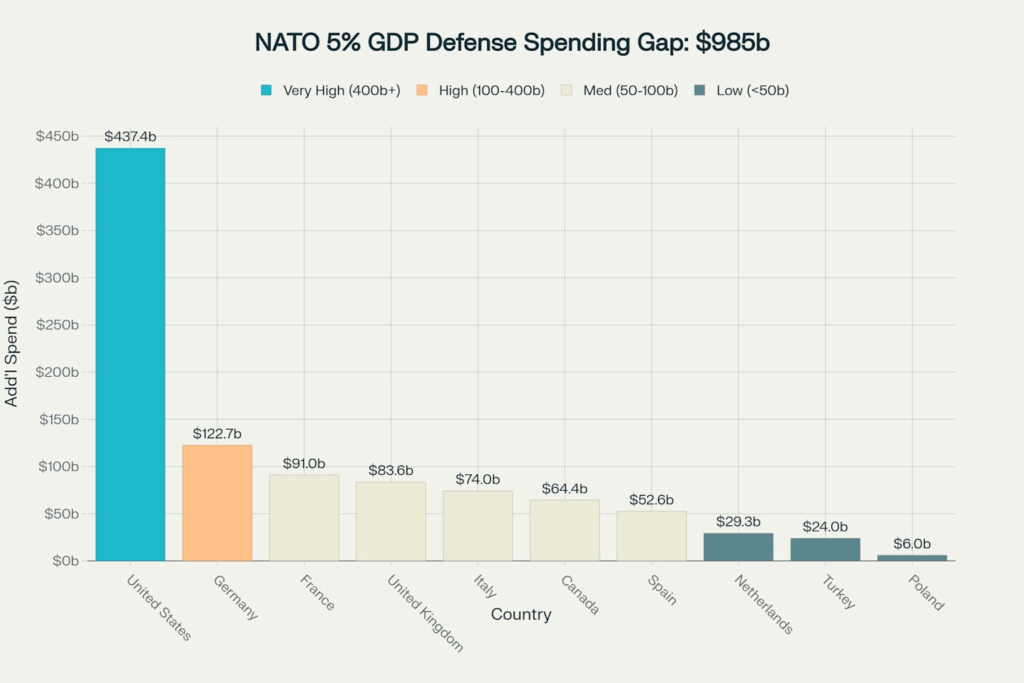
Germany alone would need to find an additional $123 billion annually—equivalent to roughly half its entire federal budget. France would require $91 billion more, Italy $74 billion, and even smaller economies like the Netherlands would face $29 billion in new defense obligations. Collectively, just ten major NATO countries would need to identify nearly $1 trillion in additional annual spending, equivalent to more than the entire U.S. education budget.
These figures represent not merely accounting adjustments but fundamental reallocations of national resources away from healthcare, education, infrastructure, and social services that form the bedrock of democratic legitimacy. European Commission analysis suggests that achieving even a 3.5% target would boost GDP by only 1.6 percentage points—a modest multiplier effect that pales beside the opportunity costs of foregone investment in productive capacity.
The Security Theater Deception
Proponents of the 5% mandate invoke the specter of Russian military production and the need for enhanced deterrence, arguing that Moscow produces as much weapons and ammunition in three months as NATO allies together make in a year. This familiar refrain conflates military spending with security effectiveness while ignoring the fundamental asymmetries that define NATO’s strategic position.
Russia’s defense spending, while substantial relative to its economy, reflects the distorted priorities of an authoritarian regime that subordinates citizen welfare to military adventurism. EU foreign policy leaders note that Russia now spends more on defense than on healthcare, education, and social policy combined—hardly a model for democratic societies to emulate. The assertion that NATO requires similar proportional spending ignores the alliance’s overwhelming advantages in economic scale, technological sophistication, and geographic positioning.
Moreover, current NATO military superiority remains decisive despite spending disparities. The United States alone contributes $818 billion to alliance defense—nearly 64% of total NATO spending and more than Russia’s entire GDP. Combined European and Canadian defense expenditure of $468 billion already dwarfs Russian military capacity when adjusted for purchasing power and technological quality. The notion that this overwhelming advantage requires near-doubling to maintain credible deterrence suggests either profound strategic incompetence or deliberate threat inflation.
Historical precedent further undermines the 5% rationale. During the Cold War, when NATO faced a genuinely peer competitor in the Soviet Union, U.S. defense spending averaged $298.5 billion annually in constant dollars—far below current levels even before the proposed increases. The idea that confronting a diminished Russia requires greater proportional effort than containing the Soviet empire at its height reveals the intellectual bankruptcy of current NATO strategic thinking.
The Democratic Deficit
Perhaps most damaging is the mandate’s complete disregard for democratic accountability and citizen priorities. Polling consistently shows that Americans prioritize domestic spending on healthcare, education, and infrastructure over defense expansion, with only a minority supporting increased military spending. European publics demonstrate similar preferences, viewing defense as important but secondary to social welfare and economic development.
Spain’s principled resistance to the 5% target illuminates this democratic tension. Prime Minister Pedro Sánchez correctly characterized the mandate as “not only unreasonable but also counterproductive,” emphasizing Spain’s commitment to social policies, diplomacy, development aid, global trade and the welfare state over military expansion. This position reflects not weakness but wisdom—recognition that true security emerges from prosperous, educated, and healthy societies rather than military hardware.
The economic evidence supports Spain’s stance. Research consistently demonstrates that increased military expenditure crowds out productive investment, reducing long-term growth prospects and undermining the fiscal foundation necessary for sustained defense capability. Studies of NATO countries show that higher defense spending correlates with increased out-of-pocket healthcare costs, as military budgets displace social spending and force citizens to shoulder greater individual responsibility for basic services.
Toward Rational Defense Policy
NATO’s security challenges require sophisticated responses that enhance rather than undermine alliance solidarity and democratic governance. The current 2% spending target, finally achieved by nearly all members, provides sufficient resources for credible deterrence when combined with strategic modernization and improved coordination. Rather than pursuing arbitrary spending increases, NATO should focus on eliminating redundancy, enhancing interoperability, and addressing the critical capability gaps that reflect poor planning rather than insufficient funding.
The alliance’s chronic over-reliance on expensive American military systems, which account for the vast majority of defense equipment supporting Ukraine operations, demonstrates how increased spending often enriches defense contractors rather than enhancing security. European nations would derive greater strategic value from developing indigenous defense industrial capacity and reducing dependence on costly imports than from simply escalating expenditure levels.
Furthermore, genuine security in the 21st century requires addressing climate change, economic inequality, and democratic backsliding—challenges that military spending cannot resolve and may exacerbate. The nearly $1 trillion in additional NATO spending contemplated under the 5% mandate could alternatively fund massive investments in renewable energy, education, healthcare, and infrastructure that would genuinely enhance societal resilience against diverse threats.
The 5% defense spending mandate represents a fundamental misunderstanding of security in democratic societies, prioritizing military expansion over the social foundations that make such societies worth defending. NATO should abandon this dangerous path and return to rational defense policy that balances legitimate security needs with democratic accountability and fiscal responsibility. Only by rejecting the siren call of militarization can the alliance preserve both its strategic credibility and its democratic character.
Editor’s Note: This is an opinion column and represents the views of the author. It does not necessarily reflect the views of this publication.